
Introduction to Re-Thermalization Data Center
The idea of re-thermalization data center is no longer optional, especially in the era of Generative AI where rack power density can reach 50 to 100 kW. For years, many operators have relied on a conservative approach by keeping inlet temperatures between 18°C and 20°C, assuming that lower temperatures automatically mean better reliability.
In reality, that assumption no longer holds.
Running a data center too cold significantly increases cooling energy consumption, and from a thermodynamic standpoint, it is simply inefficient. With modern standards such as ASHRAE TC 9.9, operators now have more flexibility to increase operating temperatures in a controlled way without sacrificing performance.
This is where re-thermalization data center becomes relevant. It is not about making systems hotter, but about running them smarter.
ASHRAE Standards in Re-Thermalization Data Center
One of the biggest concerns around re-thermalization data center is hardware reliability. Many still assume that higher temperatures will damage equipment, but current standards tell a different story.
ASHRAE defines two key operating ranges. The recommended range (18°C to 27°C) is designed for long-term stability, while the allowable range (Class A1 to A4) extends up to 35°C or even 45°C under controlled conditions with proper monitoring.
In practical terms, this means operating a re-thermalization data center at 24°C to 26°C is still well within a safe range, while also opening the door to significant energy savings. The conversation is no longer about safety, but about efficiency.
Thermal Analysis in Re-Thermalization Data Center and the Real Sweet Spot
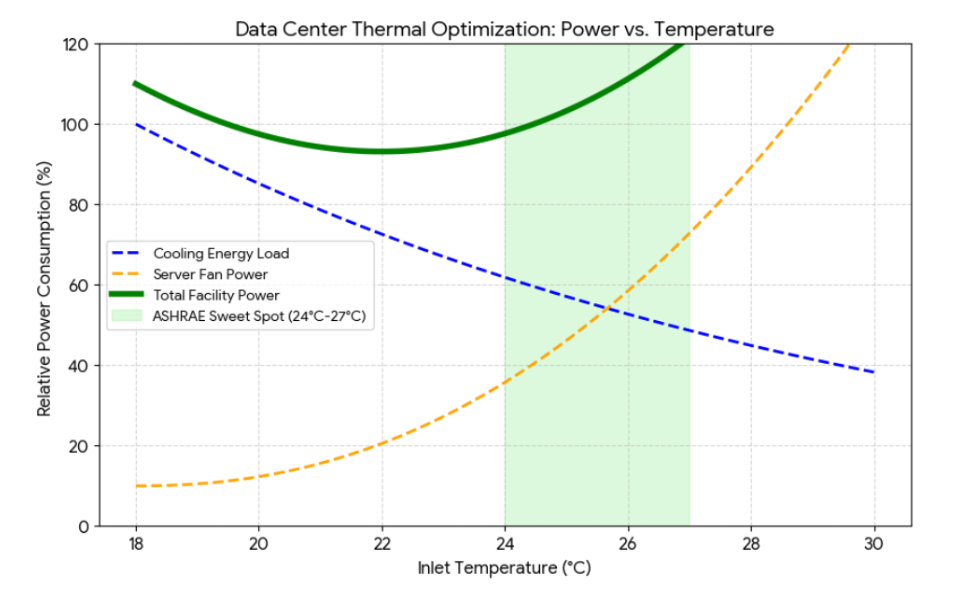
The graph above captures the core idea behind re-thermalization data center. As inlet temperature increases, cooling energy demand drops because chillers and air conditioning systems do not have to work as hard. This is where the biggest efficiency gain comes from.
However, the system does not get more efficient indefinitely.
At the same time, server fan power starts to increase. Internal fans spin faster to maintain safe chip temperatures, especially for CPUs and GPUs under heavy workloads.
If you look at total facility power, it forms a U-shaped curve. At lower temperatures, energy is wasted on excessive cooling. At higher temperatures, fan power consumption rises sharply. The optimal point sits somewhere in between.
In most modern setups, that sweet spot falls between 24°C and 27°C, making it the ideal range for re-thermalization data center optimization.
Fan Laws in Re-Thermalization Data Center
To understand this trade-off, we need to look at how fans behave.
In a re-thermalization data center, increasing temperature reduces cooling demand but forces internal fans to work harder. The important detail here is that fan power does not increase linearly. It grows exponentially with speed.
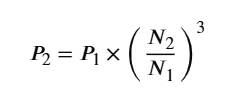
Where P represents power and N represents fan speed. This means even a small increase in fan speed can result in a significant jump in power consumption.
This is why pushing temperatures too high can backfire in a re-thermalization data center strategy.
Finding the Efficiency Balance Point
In practice, raising the temperature from 20°C to 25°C delivers clear benefits. Cooling systems become more efficient, and energy savings are immediate.
But once temperatures move beyond 27°C to 28°C, fan power starts increasing rapidly. At that point, the energy saved from cooling begins to shrink.
This is why most operators settle around 24°C to 26°C. It is the point where cooling efficiency is maximized without triggering excessive fan power consumption.
Re-Thermalization Data Center in the AI Era and Cooling Limitations
AI workloads are changing the equation entirely.
Modern GPUs used for AI can exceed 700W per chip, creating extremely high heat density. Traditional air cooling struggles to keep up because air has relatively low heat transfer capacity.
As a result, many re-thermalization data center environments are shifting toward liquid cooling, which is far more effective at removing heat from high-density racks.
However, higher operating temperatures also reduce thermal buffer time during cooling failures. Systems can heat up faster, leaving less time to respond. To address this, many operators are adopting Thermal Energy Storage systems as a backup mechanism.
Economic Impact of Re-Thermalization Data Center: 18°C vs 25°C
| Component | 18°C (Traditional) | 25°C (Re-Thermalization Data Center) | Impact |
|---|---|---|---|
| Cooling Energy | 100% | 57% – 60% | Up to 43% savings |
| PUE | 1.6 – 1.8 | 1.1 – 1.3 | Significant improvement |
| Free Cooling | Limited | Maximized | Reduced chiller usage |
| Fan Power | Low | +5% – 8% | Minor trade-off |
| Payback Period | – | 6 – 8 months | Fast ROI |
| Hardware Lifespan | Maximum | Optimal | No significant impact |
From a financial perspective, re-thermalization data center is one of the most efficient strategies available according to industry best practices. Every 0.5°C increase in inlet temperature can reduce cooling energy costs by around 4% to 5%.
While fan power increases slightly, the overall savings from reduced cooling demand are significantly larger, resulting in a strong and fast return on investment.
Risk Mitigation in Re-Thermalization Data Center
Of course, increasing temperature requires proper control.
A re-thermalization data center setup must include precise airflow management to avoid hotspots. Without it, higher temperatures can negatively impact performance.
Hot aisle and cold aisle containment systems are essential to prevent mixing between hot and cold air. In addition, temperature sensors should be installed at multiple levels within each rack to detect anomalies early and maintain stable operation.
Conclusion: Re-Thermalization Data Center as a New Standard
At its core, re-thermalization data center is about balance.
It is not about running systems hotter, but about running them more efficiently. By operating at around 25°C, data centers can significantly reduce energy consumption, improve PUE and still support demanding AI workloads as seen in large-scale data center operations
In the AI era, efficiency is no longer optional. And re-thermalization data center is quickly becoming a key strategy to achieve it.


