
Indonesia’s digital infrastructure landscape is undergoing a major transformation with the emergence of local cloud regions established by global hyperscalers. This shift is not merely about relocating servers to comply with data sovereignty requirements, but rather a strategic catalyst that is redefining the competency standards of national digital talent. In the era of Artificial Intelligence, particularly Generative AI, industry demands are evolving beyond system management toward designing adaptive, scalable, and automation-driven system architectures.
AI as an Accelerator of Infrastructure and Skill Demand
The rapid growth of AI is driving an unprecedented demand for high-performance computing infrastructure, which can only be efficiently delivered through large-scale cloud platforms. This development is creating a strong demand for highly specialized technical skills within Indonesia.
Digital talent is now expected to understand GPU and TPU acceleration to manage complex AI workloads, including performance optimization on specialized chips such as NVIDIA H100 and Google TPU. In addition, expertise in data engineering is becoming increasingly critical, particularly in building secure, efficient, and low-latency data pipelines for AI model training. The presence of local cloud regions further enhances this capability by enabling faster data processing closer to the source.
Paradigm Shift: From Operators to Architects
Cloud transformation is fundamentally reshaping the role of IT professionals. Previously focused on managing static on-premise infrastructure, digital talent must now adapt to dynamic, software-defined environments.
Infrastructure as Code (IaC) has become a new standard, where infrastructure is managed through scripts using tools such as Terraform or Ansible. This enables full automation, including self-healing systems in modern data centers. At the same time, mastery of cloud-native architecture, including microservices and containerization with Kubernetes, is essential to ensure applications can run in a modular, flexible, and scalable manner.
Economic Multiplier Effect and Job Creation
Global cloud investments generate not only technological impact but also significant economic value. The expansion of hyperscalers is projected to create more than 100,000 new jobs and contribute substantially to Indonesia’s GDP growth.
Indonesian talent now has access to globally recognized certifications aligned with international standards, enhancing competitiveness in the global workforce. Furthermore, the presence of local cloud regions strengthens the implementation of regulations such as the Personal Data Protection Law, which drives increasing demand for professionals in cybersecurity and compliance.
Talent Gap Challenges in Indonesia
Despite these opportunities, Indonesia continues to face a significant digital talent gap. The demand for digital talent is projected to reach 12 million by 2030, while the current supply remains insufficient to meet industry needs. Formal education systems produce only around 100,000 to 200,000 graduates annually, whereas the industry requires approximately 600,000 new talents each year.
This gap is further exacerbated by the mismatch between academic curricula and the rapidly evolving needs of the cloud and AI industries. To better understand the scale of this challenge, the comparison between talent supply and industry demand can be seen in the following visualization.
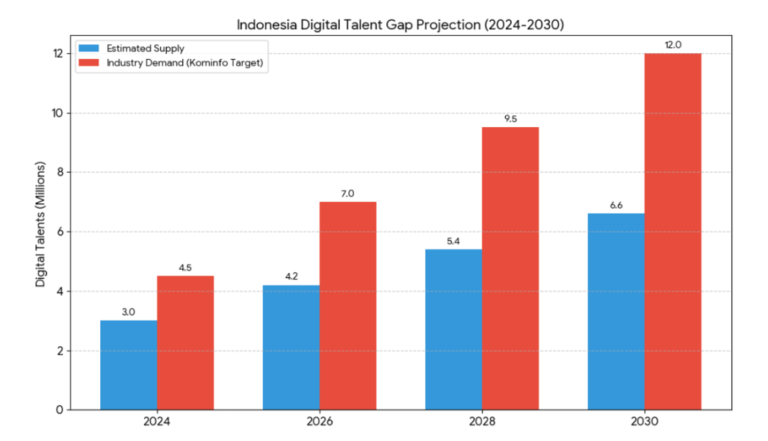
The chart above illustrates that the gap between digital talent supply and demand continues to widen toward 2030. This highlights the urgent need for stronger collaboration between government, industry, and educational institutions to build a more relevant and adaptive talent development ecosystem.
Top 5 Critical Skills in the Cloud and AI Era (Global Standard)
To address industry demands, five critical skills have emerged as top priorities in developing Indonesia’s digital talent.
- Cloud-Native Architecture and Containerization
Proficiency in Kubernetes and Docker is essential, as modern applications must run in modular and scalable cloud environments. - Infrastructure as Code (IaC) and Automation
Mastery of tools such as Terraform, Ansible, or Pulumi enables operational efficiency through full infrastructure automation. - Data Engineering and AI Infrastructure Management
Expertise in managing data pipelines, GPU workloads, and MLOps practices is crucial for AI development and deployment. - Advanced Cybersecurity and Zero Trust Architecture
Security is a top priority in cloud environments, including identity management (IAM), data encryption, and compliance with regulations such as data protection laws. - FinOps (Cloud Financial Management)
The ability to optimize cloud costs is critical to ensure efficiency without compromising performance.
IT Role Comparison Matrix: Traditional vs Cloud and AI Era
Dimension | Traditional Infrastructure Era | Cloud and AI Era |
Cost Model | High CapEx | Flexible OpEx |
Management | Manual and physical | Automated (IaC) |
Scalability | Static | Real-time elastic |
Core Skills | Server administration | DevOps, SRE, ML Engineer |
Security | Perimeter-based | Zero Trust |
From a financial perspective, re-thermalization data center is one of the most efficient strategies available according to industry best practices. Every 0.5°C increase in inlet temperature can reduce cooling energy costs by around 4% to 5%.
While fan power increases slightly, the overall savings from reduced cooling demand are significantly larger, resulting in a strong and fast return on investment.
Conclusion: Indonesia as a Southeast Asia Digital Hub
The expansion of global cloud infrastructure presents a significant opportunity for Indonesia to transition from a technology consumer to a digital innovation hub in Southeast Asia. With increasingly mature infrastructure and talent development aligned with industry needs, Indonesia holds strong potential to become a competitive digital hub at both regional and global levels. However, the success of this transformation will largely depend on the country’s ability to close the digital talent gap through targeted and collaborative skill development strategies.


