
Micro Data Centers are becoming an increasingly important component of modern digital infrastructure as organizations seek to deliver low-latency services beyond major metropolitan areas. As digital banking, e-commerce, industrial IoT, and high-definition content streaming continue to expand across regional markets, the demand for fast, reliable, and resilient infrastructure is growing at an unprecedented pace.
For decades, digital ecosystems have relied heavily on centralized architectures, with hyperscale cloud facilities concentrated around capital cities and major economic hubs. While this model provides economies of scale, it becomes increasingly inefficient as users, applications, and connected devices become more geographically distributed. Longer data paths inevitably introduce higher latency, increase network congestion, and drive up bandwidth costs.
To address these challenges, organizations are increasingly adopting Micro Data Centers and edge computing architectures. By bringing processing capabilities closer to where data is generated and consumed, businesses can improve responsiveness, optimize network resources, and support digital growth beyond major cities.
Why Centralized Infrastructure Creates Regional Latency Challenges
Traditional data center architectures were built around centralization. Large facilities located in major metropolitan areas process and store workloads for users across entire countries or regions. While this approach has supported the growth of cloud computing, the rapid expansion of digital activity outside urban centers has exposed several limitations.
One of the biggest challenges is network congestion. Every transaction, video stream, IoT signal, and application request generated in regional areas must travel long distances before reaching centralized servers. As traffic volumes increase, long-haul communication links become increasingly congested, forcing enterprises and service providers to invest more heavily in bandwidth capacity.
Distance also has a direct impact on latency. Although delays are measured in milliseconds, they can significantly affect applications that require real-time responsiveness. Mobile banking transactions, e-commerce flash sales, industrial automation systems, and video conferencing platforms all depend on fast and reliable communication between users and computing resources.
Even relatively small delays can result in buffering, transaction failures, and degraded user experiences. As digital expectations continue to rise, maintaining low latency has become a business necessity rather than simply a technical objective.
Understanding Micro Data Centers
Micro Data Centers provide an alternative to traditional infrastructure by bringing compute resources closer to users and data sources. In essence, they are compact versions of conventional data centers that integrate all critical components into a secure enclosure containing one or several IT racks.
Despite their smaller footprint, Micro Data Centers include precision cooling systems, independent UPS units, fire suppression mechanisms, environmental monitoring sensors, and physical security controls. This integrated design allows organizations to deploy infrastructure much faster without the need to construct large facilities.
Their compact nature also offers remarkable flexibility. Micro Data Centers can be installed inside bank branches, telecommunication sites, warehouses, retail outlets, manufacturing plants, and remote industrial facilities. This enables organizations to position computing resources precisely where low-latency performance is needed most.
Standards and Remote Management
Modern Micro Data Centers are designed to meet international standards for reliability and security. Many deployments align with ANSI/TIA-942 requirements, while IP55 and IP66 protection ratings help safeguard infrastructure from dust, humidity, and water exposure.
Information security is equally important. Many deployments follow ISO/IEC 27001 principles to ensure proper access control and asset protection.
Managing distributed infrastructure would also be difficult without centralized visibility. Data Center Infrastructure Management (DCIM) platforms provide real-time monitoring of power systems, cooling performance, environmental conditions, and physical security across multiple locations. Through centralized dashboards and automated alerts, operators can proactively address anomalies before they lead to service disruptions.
How Micro Data Centers Enable Edge Computing
Micro Data Centers play a central role in edge computing by changing where data is processed. Instead of sending every piece of information to distant cloud facilities, critical workloads are handled closer to users and connected devices.
In traditional architectures, raw data generated by applications, sensors, and users must travel long distances before being processed. Edge computing shortens this journey by allowing Micro Data Centers to process information locally and transmit only relevant data or long-term records back to centralized clouds.
By reducing the physical distance that data must travel, organizations can dramatically improve responsiveness and reduce dependence on long-haul networks.
Traditional Centralized Networks vs. Edge Computing Architectures
Figure 1 illustrates the difference between traditional centralized infrastructures and edge computing architectures supported by Micro Data Centers. Rather than sending all raw data to distant hyperscale facilities, edge architectures introduce localized processing closer to users and connected devices.
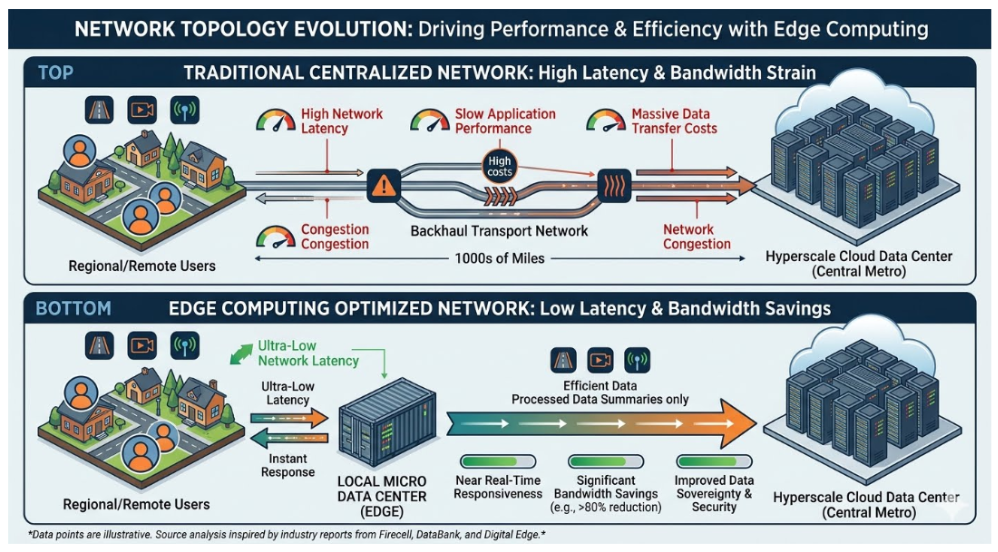
Figure 1. Comparison between traditional centralized architectures and edge computing deployments enabled by local Micro Data Centers. By processing data closer to users, organizations can reduce latency, lower bandwidth consumption, and improve overall responsiveness.
Industry observations show that centralized architectures often experience latency ranging from 50 milliseconds to more than 200 milliseconds depending on geographical distance. By introducing Micro Data Centers closer to users, organizations can reduce network distance by up to 90 percent, lowering latency to approximately 1 to 10 milliseconds.
These improvements are particularly valuable for digital banking, industrial IoT, manufacturing systems, AI applications, and other workloads that require near real-time responsiveness.
Beyond Performance: The Business Benefits of Micro Data Centers
While latency reduction is often the most visible advantage, Micro Data Centers provide benefits that extend far beyond speed improvements.
Lower Bandwidth Costs
Processing data locally reduces the amount of traffic that must traverse long-distance networks. Instead of transmitting every piece of raw information to centralized facilities, only summarized insights and essential records need to travel across the network. This significantly lowers bandwidth requirements and helps organizations reduce recurring telecommunications costs.
Greater Network Resilience
Micro Data Centers also improve business continuity. In centralized environments, disruptions affecting backbone networks or submarine cables can interrupt services across entire regions. Distributed edge infrastructure introduces a level of local autonomy, allowing operations to continue even when connectivity to central facilities is temporarily unavailable.
This capability strengthens disaster recovery strategies and reduces reliance on a single point of failure.
Supporting Green Computing
Energy efficiency has become an increasingly important priority for digital infrastructure operators. One of the most widely used metrics is Power Usage Effectiveness (PUE), which measures how efficiently a facility uses energy.
Large centralized facilities often face substantial cooling overhead. In contrast, Micro Data Centers leverage enclosed airflow designs and precision cooling technologies that optimize thermal performance. As a result, many deployments achieve PUE values between 1.2 and 1.4, contributing to lower electricity consumption, reduced operating costs, and improved sustainability outcomes.
Why Micro Data Centers Matter for Indonesia
The importance of Micro Data Centers becomes especially evident in archipelagic countries such as Indonesia. Connecting more than 17,000 islands through a heavily centralized infrastructure model presents enormous technical and economic challenges. Long-distance submarine cables require substantial investment and remain vulnerable to disruptions caused by seismic activity.
To address these challenges, telecommunications providers are increasingly expanding regional edge ecosystems. TelkomGroup, for example, continues to strengthen its neuCentrIX footprint through edge deployments outside Java, including facilities in Pontianak, West Kalimantan.
By bringing infrastructure closer to regional users, these deployments help support digital banking services, agricultural IoT systems, and industrial applications while reducing dependence on long and potentially vulnerable network routes.
Centralized Data Centers vs. Micro Data Centers
Metric | Centralized Hyperscale Cloud | Micro Data Centers | Business Impact |
Average Latency | 50 ms to >200 ms | 1 ms to 10 ms | Faster and more responsive applications |
Power Usage Effectiveness (PUE) | 1.5 to >2.0 | 1.2 to 1.4 | Lower energy consumption |
Bandwidth Costs | High due to long-distance traffic | Significantly lower | Reduced operational expenses |
Deployment Speed | Months or years | Weeks | Faster time-to-market |
Network Resilience | Dependent on core connectivity | Greater local autonomy | Improved business continuity |
Physical Placement | Large industrial facilities | Branches, warehouses, factories, and telecom sites | Greater flexibility |
Security and Compliance | Facility-focused certifications | ISO 27001 and IP-rated protection | Better protection for remote sites |
Conclusion
As digital transformation continues to extend beyond major cities, infrastructure strategies must evolve accordingly. Relying exclusively on centralized facilities is becoming increasingly challenging in a world where users, applications, and connected devices are more geographically distributed than ever before.
Micro Data Centers offer a practical solution by bringing computing resources closer to where data is generated and consumed. Beyond reducing latency, they improve bandwidth efficiency, strengthen resilience, support sustainability goals, and enable organizations to expand digital services more effectively.
Ultimately, the future of digital infrastructure will depend not only on scale, but also on distribution. In that context, Micro Data Centers are emerging as a critical foundation for achieving regional digital sovereignty and delivering fast, reliable digital experiences regardless of location.


