
Artificial intelligence has become one of the biggest drivers of digital transformation worldwide. Every few months, new AI models redefine what businesses can automate, governments announce new AI initiatives, and technology companies invest billions of dollars in digital infrastructure.
Indonesia is part of this momentum. Global cloud providers continue expanding their presence, hyperscale data centers are increasing in number, and businesses across finance, healthcare, manufacturing, education, and public services are integrating AI into their operations. As these investments continue to grow, one question becomes increasingly important:
Can Indonesia AI infrastructure keep up with AI growth?
The answer depends on much more than AI software.
Behind every AI model lies an ecosystem of data centers, power systems, cooling technologies, network infrastructure, and skilled professionals who keep these critical facilities running around the clock.
Why Indonesia AI Infrastructure Matters
Indonesia has established itself as one of Southeast Asia’s fastest-growing digital economies. The country’s large population, growing internet adoption, and expanding digital ecosystem continue attracting investment from global technology companies.
AI plays a significant role in this transformation. Businesses now use AI to improve customer experience, automate business processes, strengthen cybersecurity, analyze large datasets, and accelerate innovation across industries.
However, AI does not exist in isolation.
Every AI application requires physical infrastructure capable of supporting enormous computing workloads. That infrastructure includes high-density data centers, resilient power systems, advanced cooling technologies, and high-speed connectivity.
As AI adoption accelerates, Indonesia AI infrastructure must evolve at the same pace.
AI Growth Requires More Than Powerful GPUs
Many discussions about AI focus on graphics processing units (GPUs), large language models, or software innovation. While these technologies continue pushing AI forward, they represent only one part of a much larger ecosystem.
Modern AI workloads require thousands of GPUs operating simultaneously inside data centers. These processors consume significantly more electricity than traditional enterprise servers while generating substantial amounts of heat that demand advanced cooling systems.
According to NTT Global Data Centers’ white paper Can Data Centers Keep Pace with AI?, global data center capacity is projected to grow at a compound annual growth rate (CAGR) of 23% to 30% through 2030. At the same time, the report identifies power availability as one of the industry’s biggest challenges, alongside renewable energy integration, skilled engineering talent, and infrastructure development speed.
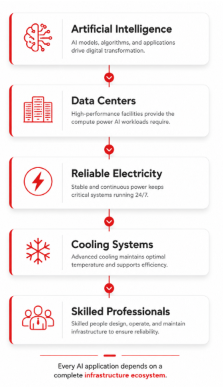
The diagram above illustrates why AI infrastructure extends far beyond software and computing hardware. Every layer depends on the one below it. Without reliable electricity, data centers cannot operate. Without efficient cooling, high-density AI servers cannot maintain performance. And without skilled professionals, none of these systems can deliver reliable services.
This shift highlights an important reality.
The future of AI depends not only on smarter algorithms but also on stronger infrastructure.
Why Power Availability Has Become a Critical Challenge
Electricity has become one of the most valuable resources in the AI era.
Every AI-ready data center depends on stable, continuous, and high-capacity power to operate thousands of servers without interruption. As AI adoption continues to grow, electricity demand increases alongside computing demand.
Unlike software development, however, power infrastructure cannot scale overnight.
Expanding transmission networks, constructing substations, upgrading electrical capacity, and integrating renewable energy require years of planning, engineering, investment, and regulatory coordination.
This creates a gap between the speed of AI innovation and the pace of infrastructure development.
While AI models continue improving every few months, supporting infrastructure often requires years before becoming operational.
Beyond Electricity: Other Challenges Facing AI Infrastructure
Power availability is only one part of the equation.
The NTT report also highlights several interconnected challenges that will shape the future of AI infrastructure worldwide.
Renewable Energy Integration
As electricity demand grows, data center operators continue increasing their investment in renewable energy to reduce carbon emissions while supporting long-term sustainability goals.
Infrastructure Development Speed
Building AI-ready facilities requires land acquisition, utility connections, permits, electrical installations, and highly specialized equipment. Every stage takes time and coordination between multiple stakeholders.
Skilled Engineering Talent
Advanced infrastructure requires people who understand how to design, operate, and maintain mission-critical environments. As more AI-ready data centers enter the market, demand continues growing for professionals with expertise in electrical systems, mechanical engineering, cooling technologies, networking, and facility operations.
What Does This Mean for Indonesia?
Indonesia has an opportunity to strengthen its position as one of Southeast Asia’s leading digital economies.
The country continues attracting investment from hyperscale cloud providers, telecommunications companies, and global data center operators. These investments create a strong foundation for expanding Indonesia AI infrastructure and supporting future AI adoption across industries.
However, infrastructure growth requires long-term planning.
Reliable electricity, resilient transmission networks, renewable energy integration, and high-performance data centers must continue expanding alongside AI demand. Countries that successfully align infrastructure development with AI growth will be better positioned to attract future investment and strengthen their digital competitiveness.
For Indonesia, this is not only an infrastructure challenge but also a strategic opportunity.
Indonesia AI Infrastructure Needs Skilled Professionals
Infrastructure does not operate by itself.
Behind every data center are professionals responsible for designing electrical systems, managing cooling technologies, maintaining critical facilities, and ensuring uninterrupted operations.
As Indonesia AI infrastructure continues expanding, the industry will require more data center technicians, electrical engineers, mechanical engineers, commissioning specialists, facility engineers, and network professionals who understand mission-critical operations.
Developing this workforce requires more than academic education. Employers increasingly look for professionals with practical experience, industry-recognized competencies, and technical skills that match real operational environments.
Training and professional certification therefore become essential components of Indonesia’s AI ecosystem.
Through industry-focused training programs and professional certification, Nusantara Data Center Academy (NDCA) helps prepare future professionals for careers in the rapidly growing data center industry. By combining practical learning with industry standards, NDCA supports the development of the skilled workforce needed to strengthen Indonesia’s digital infrastructure.
As AI investment accelerates, preparing people will become just as important as expanding electricity capacity or building new facilities.
The Future of Indonesia AI Infrastructure
Indonesia has already demonstrated its ambition to become a leading digital economy in Southeast Asia. AI will continue driving innovation across industries, while new investments in cloud computing and data centers create opportunities for long-term economic growth.
Achieving that vision requires a balanced approach.
The country must continue investing in reliable electricity, resilient digital infrastructure, sustainable energy solutions, and high-performance data centers. At the same time, Indonesia must develop a workforce capable of operating the critical infrastructure that supports AI.
Technology may power the future.
People will keep it running.
By strengthening Indonesia AI infrastructure through investment, innovation, professional training, and industry certification, Indonesia can build a stronger foundation for sustainable AI growth and long-term digital competitiveness.
Reference:


