
Behind the rapid wave of digital transformation lies a pressing global question: how can advanced technology coexist with environmental sustainability?
As artificial intelligence (AI) and quantum computing continue to evolve, Indonesia’s data center industry is entering a new phase—one that demands balance between technological innovation and ecological responsibility.
The challenge is no longer just about ensuring capacity and connectivity, but how to build digital infrastructure that grows efficiently, sustainably, and responsibly.
This topic was explored in depth in the Nusantara Podcast, presented by the Nusantara Data Center Academy (NDCA), hosted by Sari Oktaviani, featuring two leading experts: Hendrikus Hendra Gozali (Country Head, ST Telemedia Global Data Centers Indonesia) and Stephanus Oscar (CEO, EDGE DC Indonesia).
Together, they discussed the future direction of Indonesia’s data center industry—from the transition to green energy and sustainable design, to how AI and quantum computing are reshaping operational efficiency and power demands.
Energy, AI, and the Sustainability Challenge
Data center operations are inseparable from massive energy consumption. In fact, power requirements can reach up to 20 times that of a typical office building.
While a shopping mall may only consume around 6 MVA~5.4 MW, a single data center can reach 100 MW, and with power efficiency (PUE) factored in, totals can soar beyond 150 MW.
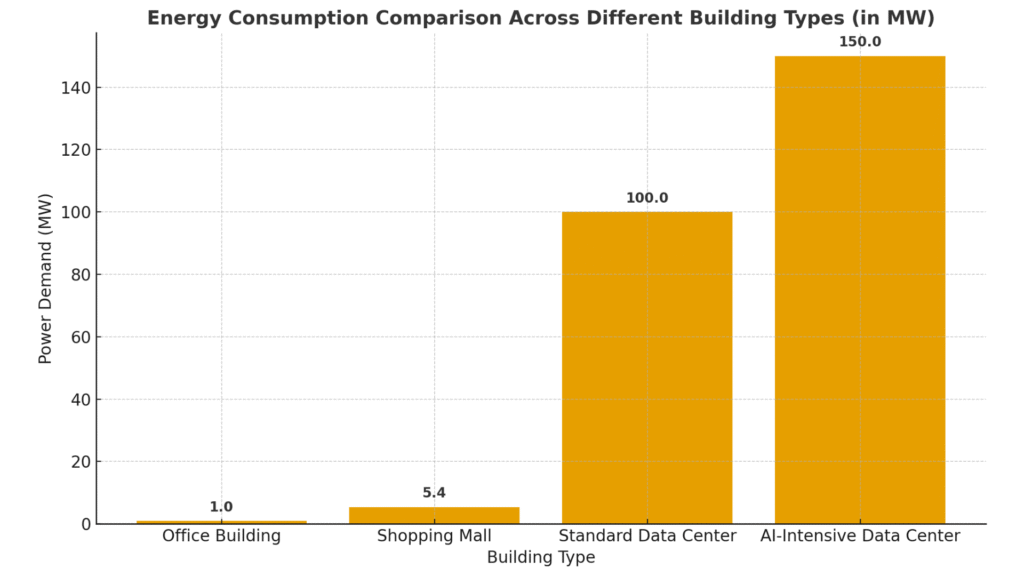
The chart below highlights how power requirements escalate dramatically across different building types. While office buildings operate at a baseline of 1×, shopping malls can reach 6 MVA, standard data centers consume around 100 MW, and AI-intensive facilities may exceed 150 MW, reflecting the surging energy demand driven by advanced computing workloads.
This trend underscores the critical importance of energy efficiency strategies for data center operators moving forward.
“A data center must run 24 hours a day, but we also have to consider the surrounding environment and its ecological impact,” explained Hendrikus.
To address these challenges, operators are taking concrete steps, such as:
Purchasing Renewable Energy Certificates (REC) to ensure electricity comes from green sources.
Offsetting generator emissions through carbon credits.
Aiming to achieve net-zero targets even earlier than government mandates.
These actions show that Indonesia’s data center sector is becoming increasingly mature and proactive in tackling environmental issues.
Smarter Cooling for Rising AI Workloads
AI has revolutionized the way data is processed and stored—but behind this sophistication lies a much heavier demand for power and cooling. If a traditional server rack once required only 2–3 kW, AI workloads now push that figure to 20–50 kW per rack.
To reduce overall energy consumption, the industry is adopting higher operating temperatures, shifting from 18°C to as high as 30–35°C. Technologies like StatePoint Liquid Cooling are now being deployed to maintain high performance while boosting efficiency.
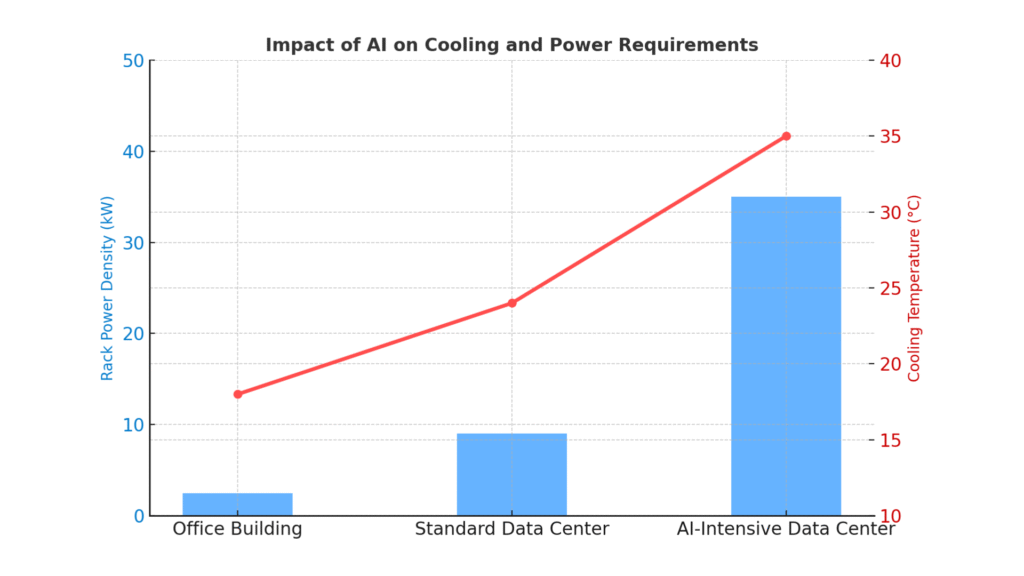
As AI workloads intensify, data centers face a steep rise in rack power density—from 2–3 kW in traditional setups to over 50 kW in AI-driven environments.
At the same time, cooling temperatures are increasing from 18°C to 35°C, signaling a shift toward smarter, more adaptive cooling systems that balance sustainability and efficiency.
This transformation represents not only a technical shift but also a paradigm change in how digital infrastructure is managed.
EDGE DC stands as a leading example, implementing:
- 100% Renewable Energy Certificates (REC) at its Jakarta facility.
- Collaboration with PLN for green energy sourcing.
- Deployment of liquid cooling to reduce PUE.
- Waste management partnership with Waste4Change.
- Pursuit of LEED Gold Certification for sustainable building design.
Power and Cooling Comparison
Before diving deeper into sustainability strategies, it’s essential to understand how dramatically power and cooling demands differ across various building types.
As data centers evolve—especially with the rise of AI and quantum computing—the contrast between conventional facilities and AI-intensive environments becomes increasingly stark.
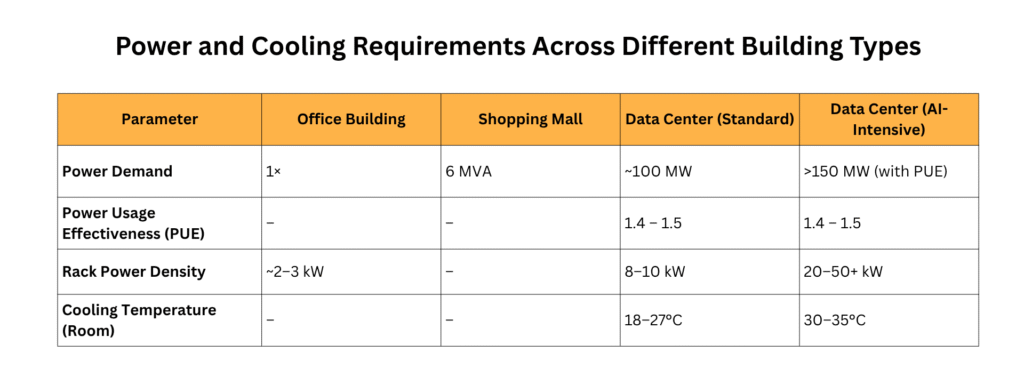
The table above highlights the massive rise in both power demand and cooling requirements needed to support increasingly complex AI workloads. These figures emphasize the importance of innovative energy management and advanced cooling solutions to maintain both performance and sustainability.
Collaboration and Adaptation for a Digital Future
Both STT and EDGE DC recognize that digital transformation isn’t just about technology—it’s about collaboration with clients and accountability to future generations.
Facility design today is no longer one-directional; it’s a collaborative process between operators and clients to ensure alignment with specific operational needs.
The industry mindset has also evolved from rigid standards to a more flexible, cooperative, and innovation-friendly approach.
Many clients now bring their own sustainability initiatives, reinforcing a shared commitment to a greener future.
Amid the “Tech Winter,” Data Centers Keep Growing
The discussion concluded with a shared message of optimism and the importance of nurturing digital talent.
“Indonesia has the potential to produce data center professionals recognized globally,” said Hendrikus.
Oscar added, “As global players enter the market, industry standards rise—but that also opens new career opportunities for young local talent.”
Optimism, Talent, and New Opportunities
The so-called “Tech Winter” raised global concerns, yet for the data center industry, this period is less of a freeze and more of a transition season.
According to Hendrikus and Oscar, the demand for data storage continues to surge—from smartphones and cloud services to AI-driven applications.
As long as humans continue to generate data, data centers will remain the backbone of the digital economy.
Glossary of Key Terms
|
Term |
Definition |
|
REC |
Renewable Energy Certificate that verifies electricity sourced from green energy. |
|
PUE |
Power Usage Effectiveness — the ratio of total energy consumption to IT equipment energy. |
|
LEED |
A global certification standard for environmentally friendly building design. |
|
Carbon Credit |
A tradable permit allowing the emission of one ton of CO₂. |
|
Liquid Cooling |
Cooling technology using liquid, more efficient than traditional air-based systems. |
|
AI (Artificial Intelligence) |
Computer systems that mimic human intelligence, increasing data center workloads. |
|
Quantum Computing |
Computing technology based on quantum mechanics principles, requiring specialized infrastructure. |
|
Tech Winter |
A temporary slowdown in global technology investment cycles. |
Conclusion
This podcast episode illustrates how Indonesia’s data center industry is advancing toward a greener future—tackling energy and technology challenges through innovation and responsibility.
With cross-sector collaboration, green energy adoption, and digital talent readiness, Indonesia is poised not just to be a technology user, but a pioneer of sustainable digital infrastructure in Southeast Asia
For more details, listen directly to the podcast on YouTube Nusantara Academy and don’t forget to register for training by contacting https://wa.me/6285176950083


