
Did you know that by 2030, data centers worldwide are projected to generate 2.5 billion metric tons of carbon emissions? That amount equals nearly 40% of total building emissions in the United States, according to Morgan Stanley.
As the digital industry continues to grow rapidly, the demand for sustainable and efficient infrastructure has never been more critical. The big question is: how can data centers continue to expand without compromising the planet?
That question became the main topic in the latest episode of Podcast Nusantara, featuring two experts in the field: Christina Ng, Head of Facilities Management at Colliers Indonesia, and Ricardo Purba, Chief Operating Officer at OCS Indonesia. The discussion was hosted by Citra Ananda, Operations Support Manager at EDGE DC. Together, they explored how Facility Management (FM) plays a key role in building a sustainable future for data centers through the implementation of Environmental, Social, and Governance (ESG) principles.
The Key Role of Facility Management in Sustainability
According to Christina Ng, Facility Management is much more than daily operations such as maintaining utilities, cooling systems, or security. It acts as a driving force behind energy efficiency, waste management, and green building certification.
She emphasized that sustainability should be applied throughout the entire data center lifecycle, including site selection, design, construction, and asset management.
Ricardo Purba added that sustainability also includes social and governance aspects. FM teams are responsible for maintaining employee well-being, engaging local communities, and ensuring business ethics and transparency. He also noted that certifications like ISO 14001 are strong evidence of a company’s commitment to global environmental standards.
Technology for Energy Efficiency
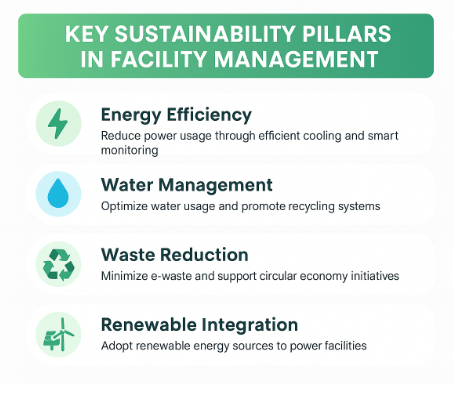
Technologies such as AI, IoT, and automation have become catalysts in creating sustainable data centers. Through dynamic cooling and predictive maintenance, Facility Management can:
- Optimize energy and water usage
- Reduce downtime risks
- Improve operational reliability
Data-driven monitoring systems also make ESG reporting more accurate, which strengthens transparency and builds investor trust.
Circular Economy and Responsible Waste Management
One of the most important pillars of sustainability is responsible waste management. Christina and Ricardo both highlighted the importance of applying circular economy principles, including:
- Recycling and reusing IT equipment
- Using modular and upgradable hardware
- Partnering with certified e-waste recycling providers
This approach not only reduces emissions and costs but also strengthens a data center’s position in green building certification and enhances its environmental reputation.
Risk-Based and Data-Driven Maintenance
Effective FM practices combine preventive and predictive maintenance based on operational data and manufacturer guidelines. This approach helps:
- Detect potential failures early
- Save energy and resources
- Maintain system uptime according to SLA standards
The use of AI diagnostic tools and thermal imaging has also improved maintenance efficiency and accuracy.
Water Management and Cooling Efficiency
Cooling systems contribute to the largest portion of a data center’s energy consumption. To address this challenge, FM teams have adopted several key strategies:
- Closed-loop cooling systems to minimize water waste
- Rainwater harvesting to support water conservation
- Continuous water quality monitoring to maintain equipment reliability
These methods are especially crucial in regions with limited water resources and play a major role in achieving long-term sustainability targets.
Data Transparency and ESG Reporting
Credible sustainability initiatives rely on accurate and integrated operational data. Many FM teams have transitioned from manual tracking to cloud-based digital platforms that monitor:
- Energy and water consumption
- Emissions across Scopes 1, 2, and 3
- Waste generation and recycling progress
Transparent ESG reporting enhances investor confidence, ensures regulatory compliance, and opens new opportunities for green financing.
Collaboration and a Shift in Mindset
Both Christina and Ricardo agreed that sustainability is not just a CSR trend. It has become a core part of modern business strategy. Building a culture of sustainability requires a mindset shift across all levels of the organization, from operations and legal teams to IT departments and top management.
Ricardo emphasized that investments in sustainability should be viewed as long-term strategies rather than short-term expenses. While energy-efficient technologies may require higher upfront costs, they deliver long-term savings and significant risk mitigation.
Conclusion
Implementing sustainability in data center Facility Management requires a holistic approach that integrates technology, resource efficiency, social responsibility, and transparent governance.
With the adoption of intelligent technology, circular economy practices, and strong ESG commitment, data centers can become key pillars in the transition toward a low-carbon digital economy.
Sustainability is no longer an option. It is a strategic necessity to maintain competitiveness and ensure a greener, more resilient future for the global data center industry.
For more details, listen directly to the podcast on YouTube Nusantara Academy and don’t forget to register for training by contacting https://wa.me/6285176950083


