
Why Power Resilience Matters in Data Centers
In today’s always-on digital economy, data centers serve as the backbone of modern business operations. This is especially critical for high-performance data centers, which must support continuous, high-density computing and mission-critical workloads. As high-density computing and AI workloads continue to increase, the demand placed on power infrastructure grows significantly. Ensuring a resilient and flexible power distribution system is crucial for maintaining uninterrupted operations.
In the latest episode of Nusantara Podcast, we explore how modern power design, advanced switchgear technology, and industry best practices contribute to building a future-ready electrical ecosystem for data centers. The discussion features insights from leaders with deep expertise in supporting high-performance data centers:
- Jap Sun Huang, Director, PT Jashen Mitra Sinergi
- Baron Noviyanto, Director, Greencomm Consultant
- Hosted by: Putri Astianingrum, Sales Engineer IT, PT Rittal Indonesia
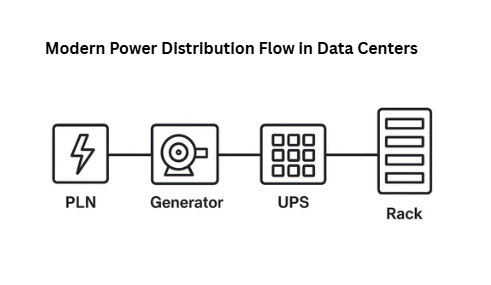
To understand how electricity flows and is protected within a data center, here is a simple overview of its power distribution, illustrating the critical infrastructure required to keep high-performance data centers resilient and operational 24/7.
Understanding Power Supply Challenges in Data Centers
Growing Complexity and the Need for Flexibility
Modern data centers face far greater challenges than those built just five years ago. At that time, electrical infrastructure was often not designed for today’s surge in AI-driven and high-density computing workloads.
Redundancy remains essential because it reduces the risk of single points of failure. However, when redundancy is added without strategic planning, the result can be an electrical architecture that is overly complex and fragile.
This is why flexibility has become a priority. Power systems must adapt to changing rack-level or row-level energy demands, allowing operational teams to upgrade or reconfigure capacity without compromising reliability.
Environmental Factors and Long-Term Reliability
Indonesia’s tropical climate introduces unique operational risks. High humidity, flooding, and extreme heat can accelerate equipment degradation and disrupt electrical performance. As a result, switchgear and other power components must operate reliably in harsh environmental conditions, especially in high-performance data centers where any disruption can directly impact critical workloads. Selecting durable equipment is essential to preventing costly downtime and protecting uptime.
Modern Switchgear: The Core of Data Center Power Distribution
What Is Modern Switchgear?
Modern switchgear, such as Vista Switchgear from S&C Electric distributed by PT Jashen Mitra Sinergi, represents a major advancement in electrical distribution. Unlike conventional switchgear that may be prone to explosions and frequent maintenance, modern switchgear uses a hermetically sealed “dead tank” design that improves safety and operational reliability.
Advantages of Modular Switchgear Design
- Scalable growth as operations expand
- Fault isolation that helps maintain uptime
- Simplified operations for safer maintenance
- Low maintenance requirements without SF6 refills
Balancing Reliability, Efficiency, and Flexibility in Medium-Voltage Systems
Redundancy Strategies: N+1 vs 2N
Common redundancy configurations such as N+1 and 2N determine the level of power resiliency. N+1 supports maintenance without downtime, while 2N offers full duplication for maximum uptime. The right choice depends on operational objectives, risk tolerance, and system complexity, particularly in high-performance data centers where continuous availability is critical.
However, achieving true concurrent maintainability typically requires two independent utility feeds. A single utility source, even with generators, may not meet global standards for high-performance data centers that must ensure uninterrupted operation under all conditions.
Intelligent and Automated Power Distribution
Today’s medium-voltage switchgear integrates smart digital controls that communicate with UPS systems and generators. This enables the system to detect faults, isolate them, and transfer loads within milliseconds. Automated responses significantly reduce downtime and human error, helping maintain continuous operation for mission-critical environments.
Integrating UPS, Generators, and Power Distribution Systems
Coordinated Systems for Maximum Resilience
A reliable electrical ecosystem blends dual utility feeds, N+1 UPS configurations, and standby generators. Automatic couplers manage power priorities so transitions occur smoothly without manual intervention, which is fundamental for ensuring uninterrupted operations in high-performance data centers.
Automation and Real-Time Communication
Modern automation platforms enable real-time monitoring, interlocking, and predictive alerts, which help protect equipment and improve operator safety. If a UPS issue occurs, the system automatically switches power sources to maintain continuity, a capability that is critical for mission-critical facilities where even milliseconds of downtime can impact service availability.
Best Practices in Operations and Maintenance
Reducing Operational Costs
Choosing explosion-proof modern switchgear reduces long-term maintenance requirements. Routine monitoring across distribution layers helps detect load imbalances, improving efficiency and reliability, which is especially important for high-performance data centers that demand continuous power stability and minimal operational interruption.
Continuous Training and Skill Development
As digital technology becomes more integrated into medium-voltage systems, ongoing training is essential. Technicians must understand both traditional electrical engineering and automation-driven power management to maintain optimal performance.
Building a Skilled Electrical Operations Team
The Importance of Structure and Leadership
A well-defined operational structure led by experienced professionals enables swift and informed decision-making during power incidents. Leaders must understand both technical and operational considerations.
Closing the Skills Gap
Collaboration between senior engineers and digitally skilled young professionals encourages knowledge transfer, strengthens operational readiness, and supports long-term resilience.
The Future: Powering Indonesia’s Digital Economy
As digital transformation accelerates, data centers in Indonesia will continue to grow in scale and complexity. This includes the rapid expansion of high-performance data centers designed to support AI, cloud, and high-density computing environments. Supporting this expansion requires resilient electrical systems, including modern switchgear, modular design, and intelligent automation. With the right strategy, data centers can sustain 24/7 continuous operations even as energy demands rise, ensuring long-term reliability for high-performance data centers across the country.
Conclusion
Building power resilience in data centers requires a holistic approach involving strategic design, technology selection, and workforce development. Modern switchgear solutions, such as those provided by PT Jashen Mitra Sinergi, deliver safer, more efficient, and scalable power distribution options. By prioritizing flexibility, automation, and continuous learning, data centers can support high-density computing and strengthen the foundation needed for high-performance data centers while driving Indonesia’s digital economy forward.
For more details, listen directly to the podcast on YouTube Nusantara Academy and don’t forget to register for training by contacting https://wa.me/6285176950083


