
With the rapid growth of digital infrastructure in Indonesia, the demand for efficient and reliable data centers is increasingly urgent. One critical aspect that determines the performance and sustainability of data center operations is its cooling system.
In the Nusantara Data Center Academy podcast, experts discuss various challenges and innovations in data center cooling in Indonesia, ranging from managing high power density, implementing energy-efficient cooling technologies, to the role of certification and local regulations.
The podcast “3 Factors That Can Optimize Your Data Center PUE”, produced by Nusantara Data Center Academy, discusses the key factors that influence Power Usage Effectiveness (PUE) in data centers, focusing on strategies to balance performance, efficiency, and sustainability. The episode is hosted by Sari Oktaviani and features two main experts:
- Herlin Haryani, President of ASHRAE Indonesia Chapter, who shares insights on technical innovations, real-time monitoring, and energy-efficient cooling strategies.
- Indri Priscillia, Managing Director of PT Tools Air Teknologi Indonesia, who discusses customization, personnel certification, and the importance of local content (TKDN) in data center operations.
During the episode, they explore challenges such as increasing power density, cooling in Indonesia’s tropical climate, and how certified teams and smart designs help achieve low PUE values (<1.5).
Cooling Challenges in Indonesia
One major issue is the increasing server power density, which can reach 20–30 kW per rack. The higher the density, the greater the heat load that the cooling system must handle. In Indonesia, air-based “free cooling” methods are rarely applicable due to the tropical climate, making energy efficiency and system precision extremely important.

Source: Johra (2022), Overview of COP for conventional vapour-compression heat pumps in buildings, Aalborg University.
The comparison chart shows how PUE (Power Usage Effectiveness) varies between data centers in tropical and temperate climates:
- Red line: Data centers in tropical climates, such as Indonesia, where PUE tends to be higher due to hotter outdoor temperatures, requiring more mechanical cooling.
- Blue line: Data centers in temperate climates, which generally have lower PUE because cooler outdoor temperatures allow cooling systems to operate more efficiently.
Importance of Customization and Flexibility
Cooling system providers emphasize customization and flexibility in design. From the initial design stage, raw data from consultants (such as airflow parameters, fan positions, and room dimensions) is sent to the R&D department to create general drawings and technical data. These designs are then reviewed with data center operators to ensure compatibility with specific needs. This flexibility allows data centers to manage high heat loads with maximum efficiency.
Advanced Cooling Technologies
Key innovations discussed include oil-less compressors with a Coefficient of Performance (COP) of 16–18, much higher than the commonly used average COP of 12–13. A higher COP means lower energy consumption for the same cooling output.
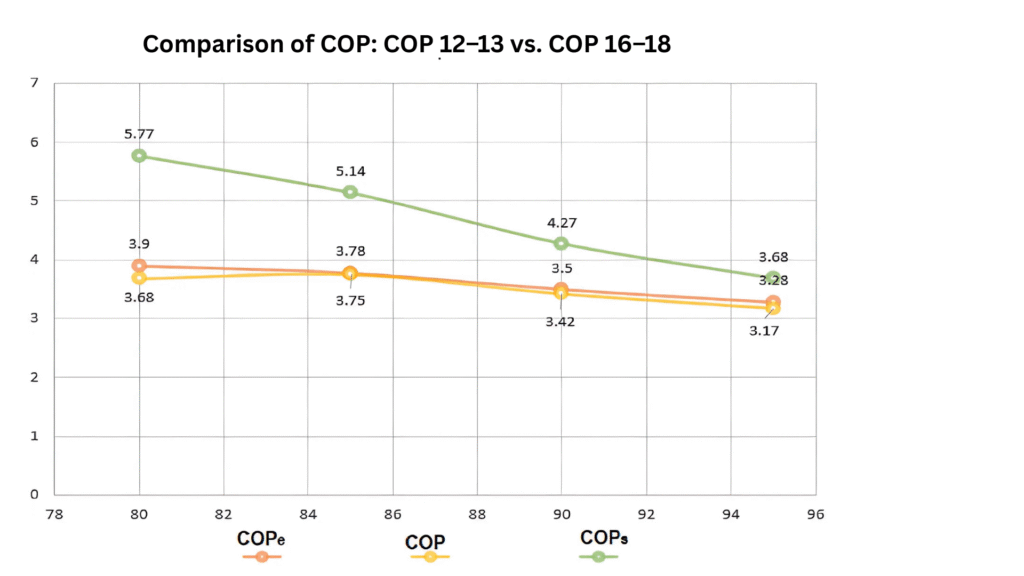
Source: Boyd Corporation (2023), Energy Consumption in Data Centers: Air versus Liquid Cooling.
The chart illustrates cooling system efficiency based on COP. The lower line represents standard systems with COP 12–13, which are less energy-efficient, while the upper line represents advanced systems with COP 16–18, which are more efficient and consume less energy for the same cooling output.
Additionally, integrating renewable energy and good building insulation plays a major role in reducing cooling load. These technologies help achieve energy efficiency goals and support the sustainability of data centers in Indonesia.
Role of Certified Personnel
Advanced technology alone is insufficient without certified experts. From design and installation to operations and maintenance, certification ensures the knowledge, skills, and professional attitude required to maintain energy efficiency and prevent downtime. Many successful data centers achieve PUE < 1.5 due to a combination of technology, experienced engineering teams, international consultation, and fully certified operations.
- Herlin Haryani emphasizes that real-time monitoring and data analysis are crucial to prevent energy waste and downtime. She notes that advanced cooling technology alone is not enough without a certified team to ensure proper operational procedures.
- Indri Priscillia highlights the importance of cooling system customization and TKDN (local content). Even with advanced machines and technologies, project success still relies on certified personnel, precise design, and local involvement to ensure sustainability and reliable after-sales service.
Real-Time Monitoring and Data Analysis
Real-time monitoring and analysis are key to preventing energy waste and system failures. By continuously tracking the status of cooling systems, power generation, and energy consumption, operators can detect issues such as dirty condensers or technical malfunctions before downtime occurs. This approach is similar to airplane monitoring, ensuring optimal operational efficiency.
Importance of Local Content (TKDN)
TKDN (Tingkat Komponen Dalam Negeri) plays a crucial role in building a sustainable data center ecosystem. By using local components, cooling products are designed for long-term operation in Indonesia, supporting local industry development, after-sales service, and reliable user services. It also reduces dependence on foreign distributors who may frequently change, ensuring service continuity.
Strategies to Balance Performance and Efficiency
To balance cooling needs and operational costs, the main strategy is selecting the right cooling system design by certified designers. Operators must have the ability to utilize the system optimally. No matter how advanced the machinery is, if installation and maintenance are done without proper procedures, energy performance and efficiency will suffer. Therefore, technology transfer and certification remain key to success.
Risks of Inadequate Cooling
Data center design must account for all aspects from the start, including redundancy, layout, and power supply capacity, to ensure the cooling system functions optimally without sacrificing energy efficiency.Inadequate cooling can result in:
- Customer loss due to downtime.
- Energy inefficiency and higher operational costs.
- Failure to meet PUE and efficiency standards.
- System vulnerability affecting service reliability.
Successful Cooling Projects in Indonesia
Several data centers in Indonesia have successfully achieved PUE below 1.5, a high indicator of energy efficiency. Key success factors include:
- Competent engineering teams.
- International consultants collaborating with local personnel.
- Certified operational and maintenance personnel.
- Precise and efficient cooling system design.
These projects demonstrate that with the right combination of technology, skilled teams, and real-time monitoring, data centers in Indonesia can operate energy-efficiently without compromising performance.
Regulation and Energy Challenges
Electricity consumption growth in Indonesian data centers is rapid, requiring government regulation of energy use and emissions. Integrating renewable energy provides a solution to balance national energy needs with emission reduction targets. Real-time monitoring also ensures that data centers do not burden national commitments to emission reduction.
Conclusion
Indonesia’s data center industry faces unique challenges: tropical climate, increasing power density, and the need for energy efficiency. Key solutions include:
- Customized and flexible cooling systems.
- Oil-less technology with high COP and renewable energy integration.
- Certified personnel at all project stages.
- Real-time monitoring and data analysis for efficiency.
- Application of TKDN to sustain the local industry.
Collaboration between advanced technology, proper design, certified teams, and supportive regulations is key to creating efficient, reliable, and environmentally friendly data centers in Indonesia.
For more details, listen directly to the podcast on YouTube Nusantara Academy and don’t forget to register for training by contacting https://wa.me/6285176950083


