
The growth of Indonesia’s data center industry isn’t just about new facilities — it’s about people. As demand for cloud, network, and AI infrastructure surges, the shortage of certified professionals has become one of the sector’s biggest bottlenecks.
In this episode, Nusantara Academy dives into the country’s digital talent readiness with insights from leading industry voices. From workforce certification trends to the urgency of upskilling programs, discover how Indonesia can bridge the talent gap and sustain its data center boom. This topic is explored in the latest podcast from Nusantara Academy, featuring three experienced voices:
- Stephanus Tumbelaka, former Managing Director at Princeton Digital Group
- Chris Yates, former Project Director at PureDC
- Hosted by Intan Tiara Dewi, Head of Building Products at Siemens Indonesia
Is the Traditional Two-Year Construction Timeline Still Relevant?
In the past, a two-year construction period was considered the standard for data centers. But according to Chris Yates, that timeline is now “too long” amid today’s accelerating market demands.
Global cloud companies and hyperscalers now require larger capacity in shorter timelines, forcing every stage — design, procurement, and construction — to be strategically managed.
Stephanus Tumbelaka adds that adopting modular design and Building Information Modeling (BIM) has become an effective solution.
BIM allows for precise 3D planning, minimizing design errors and improving collaboration, while modular systems accelerate construction without sacrificing quality.
The Impact of Artificial Intelligence on Future Data Center Design
Artificial Intelligence (AI) is reshaping data center design and operation.
AI workloads — from training to inferencing — dramatically increase power and cooling demands, reaching 50–70 kW per rack, far above the conventional 2.5–7 kW.
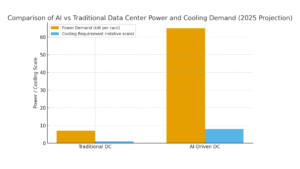
This bar chart compares average power usage per rack between AI-driven data centers (50–70 kW) and traditional facilities (2.5–7 kW), highlighting the massive surge in energy and cooling requirements due to AI workloads.
Source: Adapted from Uptime Institute & Structure Research, 2024.
Experts describe AI as a double-edged sword: it boosts operational efficiency through prediction and automation but introduces significant energy and cooling challenges.
To address this, technologies such as In-Rack Cooling and liquid-based cooling systems are emerging, though their costs remain high.
Integrating AI into operations must consider investment, efficiency, and environmental impact.
Building Skilled Local Talent for Indonesia’s Data Center Industry
Indonesia’s booming data center sector offers vast opportunities for local engineers and technicians — yet a major skills gap remains.
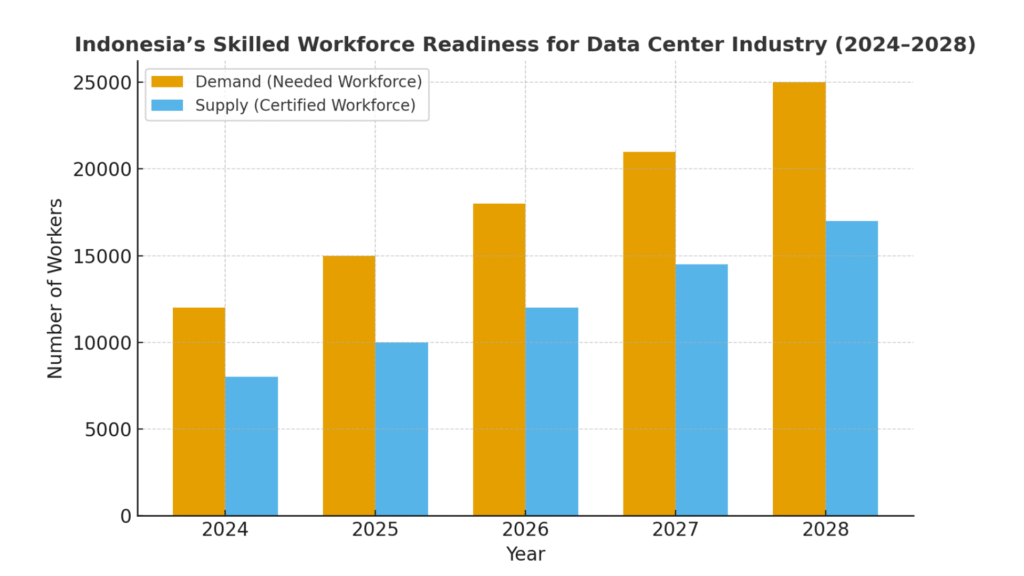
The bar chart shows the gap between workforce demand and the number of certified professionals across network, cloud, AI, and electrical engineering fields.
Source: World Bank (Digital Skills Gap Report 2024), Structure Research 2024, and Mordor Intelligence – Indonesia Data Centre Market Outlook.
Stephanus Tumbelaka stresses the importance of training, certification, and knowledge transfer from global professionals to Indonesian talent.
Key skills needed include:
- Mechanical, Electrical, and Plumbing (MEP) systems
- Precision cooling and environmental control
- Fire safety and automation systems
- Project and operations management
Beyond technical skills, workers must also master soft skills — cross-cultural communication, adaptability to new technologies, and understanding of industry regulations.
Developing skilled local talent is a long-term strategy to reduce dependency on foreign expertise and strengthen Indonesia’s digital independence.
Procurement Strategy and Supply Chain Emerging Data Center Trends in Indonesia and Southeast Asia
Experts also revealed major trends shaping Indonesia’s data center future:
- Regional Decentralization — Beyond Jakarta, cities like Batam, Surabaya, and Medan are emerging as alternative hubs due to international cable connectivity and lower operational costs.
- Green Data Centers — Operators and clients are prioritizing renewable energy and carbon footprint reduction.
- Modular and Scalable Design — Enhancing flexibility and accelerating project completion.
- Technology Integration — AI, IoT, and BIM improve predictive monitoring and operational efficiency.
- Global Collaboration — Multinational partnerships elevate technical standards and enable knowledge exchange.
These trends signal that Indonesia’s data center future will be defined by innovation, efficiency, and sustainability.
Could Nuclear Energy Power Indonesia’s Data Centers?
As energy demand continues to rise, some experts are exploring whether nuclear power could be a viable energy source for data centers.
While theoretically possible, implementation in Indonesia remains distant due to safety, regulatory, and public acceptance challenges.
For now, the focus is on:
- Expanding solar and wind energy
- Enhancing energy storage systems
- Designing facilities with low Power Usage Effectiveness (PUE)
These combined strategies aim to balance performance, operational cost, and environmental sustainability.
The Next Data Center Hotspots: Beyond Jakarta
After years of Jakarta’s dominance, experts predict the next data center boom will occur in Batam, Surabaya, and Nusantara Capital City (IKN).
Batam offers a strategic location near Singapore, which is currently limiting its own data center expansion due to land and energy constraints. The city provides robust submarine cable infrastructure, skilled labor, and favorable investment conditions.
Meanwhile, IKN is poised to become a new data center hub supported by digital infrastructure and green energy initiatives — though challenges in logistics, connectivity, and workforce readiness remain.
Future expansion strategies must consider energy access, infrastructure quality, and proximity to international networks.
Conclusion: Building a Sustainable Digital Future
Indonesia’s data center industry is entering a transformative era.
With growing cloud adoption, AI-driven workloads, and complex energy needs, cross-sector collaboration is key to long-term success.
The Nusantara Academy Podcast highlights that building a data center is not merely about construction — it’s about designing Indonesia’s sustainable digital future through:
✅ Strategic planning and efficient project management
✅ Developing competent local talent
✅ Integrating advanced technologies like AI and BIM
✅ Commitment to environmental sustainability
As Intan Tiara Dewi concludes:
“Building a data center means building a collaborative ecosystem that connects people, technology, and sustainability.”
For more details, listen directly to the podcast on YouTube Nusantara Academy and don’t forget to register for training by contacting https://wa.me/6285176950083


