
The digital industry in Southeast Asia continues to show strong growth, and Indonesia, particularly Batam, has become one of the region’s key strategic locations. Over the past few years, demand for data center facilities has increased significantly as a result of changing digital behaviors, economic expansion, and the migration of businesses toward cloud and AI-based platforms.
The latest episode of Podcast Nusantara features two key speakers:
- Indrama YM Purba, CEO of NeutraDC Nxera Batam
- Femi Sastrena, Director and Chief Commercial and Business Development Officer at Medco Power Indonesia
The discussion is moderated by Jane Sulaiman, who explores Batam’s strategic position as an emerging data center hub as well as the challenges that must be addressed to achieve efficient and sustainable operations.
Why Is Data Center Demand Increasing?
The rapid shift toward digitalization, which includes remote work, e-commerce, streaming services, and the adoption of AI, has accelerated data consumption across the region. With a population of 285 million people and more than 211 million internet users, Indonesia is positioned at the center of this digital expansion.
As a consequence, national data center capacity continues to rise. Indonesia currently operates approximately 250 MW, and projections for the coming years indicate significantly more aggressive growth.
The Impact of Singapore’s Moratorium and the Opportunity for Batam
Singapore has long served as the region’s primary data center hub. However, limitations in land, power, and water led the government to introduce a moratorium that restricted new data center developments.
Although the moratorium has since been eased with strict requirements related to sustainability and energy efficiency, many international operators have begun redirecting their interest to nearby locations such as Batam and Johor.
Batam offers several competitive advantages, which include:
- Close proximity to Singapore, which enables low-latency connectivity supported by twelve subsea cables with additional cables currently being developed.
- More available land and lower costs compared to Singapore.
- Low natural disaster risk because Batam is located outside the Ring of Fire.
- Rapid economic growth that is supported by increasing investment in digital industries.
However, Batam still faces challenges, particularly regarding power supply stability, cooling efficiency, and infrastructure readiness.
Energy Challenges and the Need for Sustainable Operations
Data centers require a large and stable power supply because they consume significant amounts of energy. Batam currently relies primarily on gas as its main energy source, while smaller portions come from coal and diesel.
Medco Power operates three power plants in Batam and recently added around 39 MW of new capacity to support the area’s growing industrial demand.
Nevertheless, global expectations for sustainability continue to strengthen. International data center operators increasingly prefer or require access to renewable energy.
Several challenges must be addressed before achieving 100 percent renewable operation, which include:
- Solar and wind power are intermittent.
- Geothermal and hydro sources require specific geographic conditions.
- Operational costs for renewable energy remain relatively higher.
- Energy storage systems are needed to ensure consistency of supply.
Despite these challenges, the direction of the industry is clear because the transition to clean energy is unavoidable.
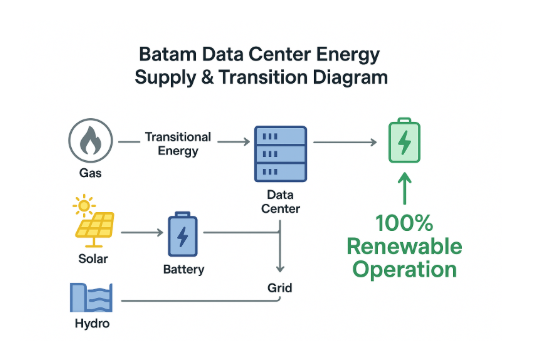
This diagram illustrates the current and future energy flow for data centers in Batam, showing gas as transitional energy and the integration of renewable sources such as solar, battery storage, and hydro toward 100% renewable operation.
Indonesia’s Renewable Energy Potential
Indonesia has an estimated renewable energy potential of 3,000–4,000 GW. The largest contributions come from:
Renewable Source | Technical Potential and Key Notes |
Solar (PV) | IESR estimates a technical potential of 3,294 GW.(IESR, 2024) |
Geothermal | Indonesia holds one of the world’s largest geothermal reserves although utilization remains limited. |
Hydro (PLTA / Mini-hydro) | Studies by the Ministry of Finance and SESA indicate a potential of around 95 GW. (Kemenkeu, 2024) |
Wind | Tens of gigawatts in potential, although development is still in its early stages. (MDPI, 2023) |
However, renewable energy utilization currently stands at only 11 to 12 percent of the national energy mix. The government aims to increase this share to 25 percent, supported by policies such as Ministerial Regulation No. 5 of 2025.
Can Data Centers Operate Entirely on Renewable Energy?
From a technical standpoint, the answer is yes. However, the transition requires a phased and strategic approach.
Ongoing strategies include:
- Hybrid power systems that combine gas, solar, and battery storage.
- Green Power Purchase Agreements.
- Grid reinforcement to connect Batam with renewable sources located outside the island.
- Development of green industrial zones designed specifically for sustainable digital infrastructure.
Indrama explains that gas will continue to serve as a transitional energy source in the medium term until full renewable operation becomes feasible.
Regional Comparison: Batam, Johor, Thailand, and Vietnam
Location | Strengths for Data Centers | Risks and Challenges |
Batam, Indonesia | Proximity to Singapore, FTZ benefits, ample land availability | Power stability, renewable transition, shortage of technical talent |
Johor, Malaysia | Lower land costs and a growing renewable energy ecosystem | Premium electricity pricing and increasing competition for power and water |
Thailand | Fast-growing digital market and stable grid | Long permitting processes and significant investments needed for renewable expansion |
Vietnam | Competitive operating costs and strong digital economy growth | Heavy dependence on coal and underdeveloped renewable and storage infrastructure |
Supporting Ecosystem: Talent, Infrastructure, and City Readiness
To compete as a regional digital hub, Batam needs a well-developed supporting ecosystem. This includes not only reliable energy and telecommunications infrastructure but also:
- Skilled data center professionals in fields such as electrical, mechanical, civil, and cooling engineering.
- Educational institutions that offer data center–specific programs or curricula.
- Supporting public facilities such as hospitals, schools, and accommodation.
- Sub-industries including equipment manufacturing, engineering services, and construction.
The talent gap is one of the most pressing challenges, yet it also presents a significant opportunity for Indonesian professionals.
Five-Year Strategic Roadmap for Batam
Energy and Infrastructure
- Green power purchase agreements for data centers
- Investment in battery and storage systems, including pumped hydro energy storage
- Integration of renewable energy sources into the Batam grid
Data Center Ecosystem
- Development of modular data center campuses
- Establishment of green industrial zones for digital infrastructure
- Collaboration among local and international investors
Talent Development
- Technical training and data center academies
- Certification programs and university–industry collaboration
- Talent retention through housing and incentive programs
Regulation and Policy
- Simplified permitting processes for data centers in Batam
- Renewable-friendly policies supporting green power agreements
- Harmonized cross-border and data governance regulations
Conclusion
Batam is entering an important phase in its journey to become a leading regional data center hub. Its combination of geographic advantages, strong connectivity, and favorable regional dynamics gives it a clear competitive edge.
To maximize its potential, Batam will need to focus on:
- Strengthening energy infrastructure, particularly renewable energy
- Encouraging collaboration among government, state-owned enterprises, and private operators
- Enhancing talent readiness
- Building a long-term, supportive ecosystem for digital industries
The transition toward clean and sustainable energy is not simply an alternative. It is a strategic requirement for Batam’s success as a competitive and future-ready digital hub.
For more details, listen directly to the podcast on YouTube Nusantara Academy and don’t forget to register for training by contacting https://wa.me/6285176950083


