
As Indonesia’s digital economy continues to grow, data centers have become the backbone of national digital transformation. However, this rapid growth raises a crucial question — can Indonesia’s data center industry go green while maintaining efficiency and reliability?
This question lies at the heart of the Nusantara Data Center Academy Podcast (Season 2, Episode 1), hosted by Rajeni Ray with guests Dondy Bappedyanto (CEO of PT Biznet Gio Nusantara) and Wisnoe Pribadi (Head of the Green Data Center White Paper Team, IDPRO). Together, they discuss the vision, barriers, and real-world efforts toward building Green Data Centers (GDC) in Indonesia — a key step in achieving the nation’s Net Zero Emissions goals.
Why Indonesia Needs Green Data Centers
Indonesia ranks as the sixth-largest carbon emitter in the world, underscoring the urgent need to reduce emissions across all sectors — including digital infrastructure.
Although data centers contribute only around 2% of global carbon emissions, their energy-intensive nature and rapid expansion make them a strategic focus for sustainable transformation.
As Wisnoe Pribadi emphasized in the podcast, “Data centers are energy-intensive, but their centralized structure offers opportunities for large-scale efficiency improvements.”
Green Data Centers thus play a pivotal role in balancing digital growth with environmental responsibility, ensuring that Indonesia’s economic progress aligns with global sustainability standards.
The Three Pillars of a Green Data Center
According to IDPRO’s White Paper draft, a Green Data Center in Indonesia is built upon three fundamental pillars:
- Sustainability: Transitioning from fossil fuels to renewable energy sources like solar and hydro.
- Environmental Protection (ESG): Maintaining ecological balance while ensuring social and governance responsibility.
- Energy Efficiency: Maximizing server and cooling system performance to reduce overall energy use.
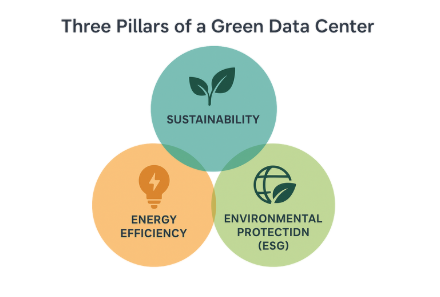
These pillars serve as the foundation for achieving measurable improvements in carbon reduction, cost optimization, and long-term operational stability.
PUE in Indonesia: Idealism Meets Reality
Power Usage Effectiveness (PUE) is the key global metric for evaluating energy efficiency in data centers. The closer to 1.0, the more efficient the facility is — meaning nearly all energy is used directly by IT equipment.
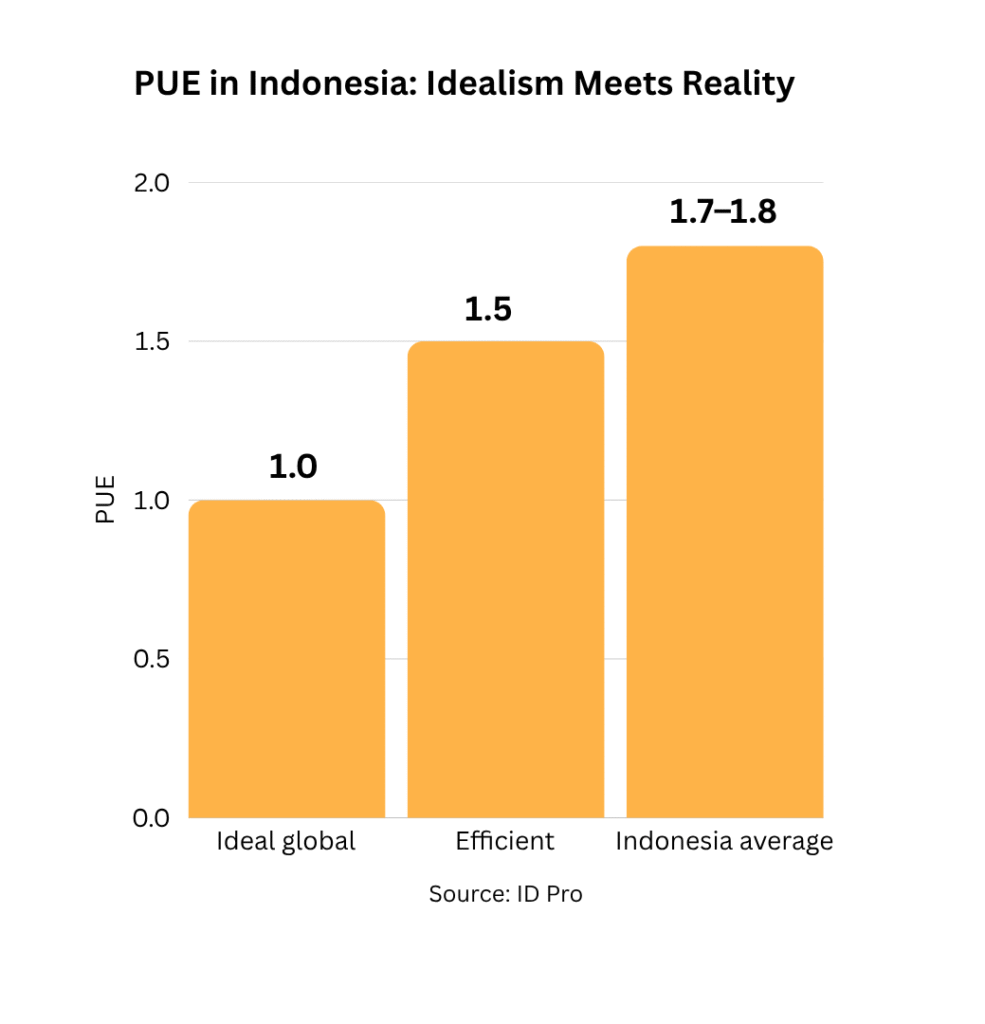
However, Indonesia’s tropical climate makes achieving a PUE of 1.0 practically impossible.
“A PUE of 1.0 is a dream in Indonesia. Realistically, we’re looking at 1.7 to 1.8 — and achieving 1.5 would already be an impressive milestone,” explained Dondy Bappedyanto.
Cooling demands, local energy infrastructure, and humidity all contribute to higher PUE scores compared to data centers in colder climates.
Renewable Energy and Regulatory Barriers
Transitioning to renewable energy for data centers remains one of Indonesia’s biggest challenges.
Despite abundant sunlight, the use of solar power faces regulatory limitations, such as:
- Restrictions on feeding excess power back to the PLN grid.
- High investment costs for battery storage.
- Large land requirements for solar farms (1 MW solar ≈ several acres of land).
Moreover, the national electricity grid is still heavily dependent on coal, making it difficult for operators to guarantee fully renewable sourcing.
Long-term energy contracts further delay the shift to cleaner power.
Legacy Infrastructure: The Hidden Challenge
Many Indonesian data centers still operate with aging infrastructure, often using servers over five years old.
Older equipment consumes more power and generates more heat, creating a vicious cycle of inefficiency.
Encouraging customers to migrate to energy-efficient servers is crucial — but this requires both financial incentives and awareness campaigns.
As the podcast discussed, data center providers must align business profitability with sustainability, rather than viewing energy consumption purely as a revenue driver.
Toward Green Data Center Certification and Standards
Currently, Indonesia has no official Green Data Center certification or regulatory framework.
However, IDPRO (Indonesian Data Center Provider Organization) is actively developing a White Paper and draft national standards to establish certification criteria.
Once implemented, such standards will help:
- Create industry-wide benchmarks for sustainability.
- Build international trust with global partners.
- Encourage green investment and innovation in the digital sector.
The Road Ahead: Collaboration for a Sustainable Digital Future
The transition toward Green Data Centers in Indonesia demands collaboration between:
- Policymakers (for clear renewable energy regulations)
- Data center providers (for efficient facility upgrades)
- Customers (for modern, energy-saving server adoption)
While technological challenges remain, the momentum is clear — sustainability is becoming a business imperative, not a luxury.
As host Rajeni Ray summarized, “Green Data Centers aren’t just a dream — they represent the future of Indonesia’s digital infrastructure.”
Conclusion
This discussion provides a comprehensive overview of the challenges and opportunities for Green Data Centers in Indonesia, emphasizing that while the country has abundant renewable resources and growing market demand for green facilities, practical, technical, and regulatory constraints must be addressed. Achieving a realistic PUE target, reforming energy regulations, upgrading technology, and establishing certification standards are essential steps forward. The commitment of the industry and government will determine Indonesia’s ability to align with global sustainability trends and reduce its significant carbon footprint through greener data infrastructure.
In the end, Green Data Centers are not just a dream but a necessity for Indonesia’s digital future — a path that demands collaboration, innovation, and long-term commitment to sustainability.
For more details, listen directly to the podcast on YouTube Nusantara Academy and don’t forget to register for training by contacting https://wa.me/6285176950083


