
The world is undergoing a rapid digital transformation that transcends borders, industries, and sectors. From artificial intelligence (AI) and cloud computing to automation and the Internet of Things (IoT), these technologies are reshaping the global economy at unprecedented speed. For Indonesia, the stakes are particularly high. As Southeast Asia’s largest economy and home to more than 270 million people, the country faces the dual challenge of leveraging digital opportunities while closing persistent skill gaps that threaten to leave parts of its population behind.
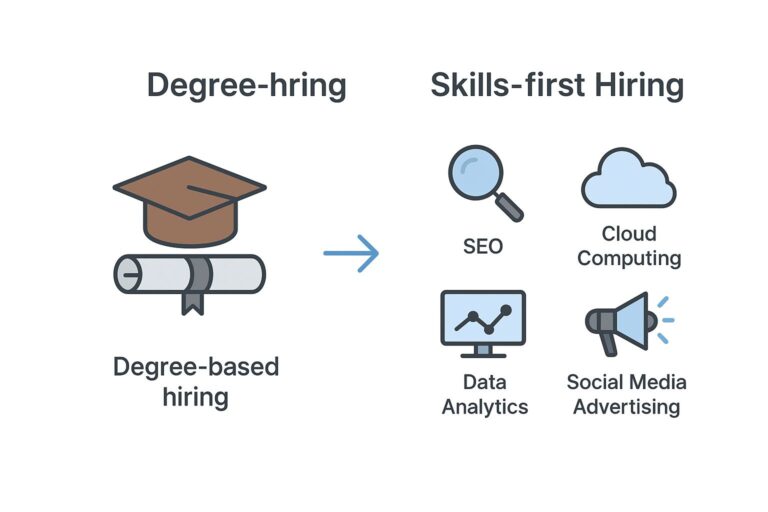
This context sets the stage for a critical paradigm shift in human capital management: skills-first hiring. This approach recognizes that, in a fast-changing environment, degrees and traditional credentials are no longer sufficient indicators of job readiness. Instead, tangible skills and competencies—demonstrated through experience, training, or certification—are what employers increasingly seek.
The Global Context of Skills-First Hiring
Indonesia is not alone in making this transition. Around the world, large multinational companies such as IBM, Google, and Microsoft have redefined their hiring criteria, eliminating degree requirements for many roles in favor of competency-based evaluations. A report by the World Economic Forum (WEF) notes that by 2030, more than 1 billion people worldwide will need to reskill to remain employable.
For emerging economies like Indonesia, the urgency is even greater. Unlike developed countries with mature education systems, Indonesia still grapples with uneven access to quality education, disparities in urban and rural infrastructure, and a workforce that must adapt quickly to technological disruption. Skills-first hiring thus becomes both a necessity and an opportunity to leapfrog traditional limitations.
From Degrees to Competencies: Why the Shift Matters
Historically, degrees were viewed as proxies for knowledge, discipline, and employability. But the mismatch between academic curricula and industry demands has grown stark. Employers often report that new graduates lack the technical and practical skills required for modern roles.
The skills-first model addresses this mismatch by focusing on what candidates can actually do rather than what academic credentials they hold. For example:
- A digital marketer who has mastered SEO, content analytics, and social media advertising may be more valuable than a graduate with a generic business degree.
- A vocational school graduate skilled in cloud infrastructure can contribute immediately to IT projects, even without a university diploma.
Yet, this shift also implies that hiring is only the first step. Companies must sustain skill relevance through lifelong learning systems, where upskilling and reskilling are integrated into the employee journey.
The Digital Divide: More Than Connectivity
At first glance, Indonesia’s internet penetration—now surpassing 78%—suggests strong digital readiness. However, the reality is more complex. Internet access does not automatically translate into productive usage. A rural entrepreneur with a smartphone, for instance, may still lack the digital literacy to use e-commerce platforms effectively. Similarly, many young people spend hours online but are not acquiring employable skills.
This highlights the second layer of the digital divide: the ability to use digital tools meaningfully. It is a divide shaped by education quality, socio-economic status, and exposure to opportunities. Unless this divide is narrowed, digital transformation risks widening inequality instead of fostering inclusive growth.
Government as a Catalyst: The Super Tax Deduction (STD)
Recognizing these challenges, the Indonesian government has stepped in with policies to encourage private-sector engagement in workforce development. The Super Tax Deduction (STD) is one such initiative, offering generous tax incentives to companies that invest in training, internships, and collaboration with vocational schools.
This policy is significant for several reasons:
- Aligning incentives: By reducing financial burdens, companies are more willing to invest in skill-building.
- Closing gaps: Vocational schools benefit from real-world input, ensuring curricula remain aligned with market needs.
- Encouraging CSR: Beyond compliance, companies gain reputational benefits by contributing to national workforce readiness.
If implemented effectively, STD can act as a cornerstone policy that bridges education and industry in ways that go beyond traditional classroom teaching.
Education-Industry Collaboration: A Symbiotic Relationship
Education systems alone cannot keep pace with the velocity of technological change. Universities and vocational institutions often face bureaucratic hurdles that delay curriculum updates, while industries demand skills that evolve every year. The solution lies in collaboration.
- Industry’s role: Provide feedback on emerging technologies, create internship opportunities, and co-develop training modules.
- Education’s role: Ensure foundational knowledge, adapt curricula, and integrate industry-certified programs.
- Training centers and bootcamps: Offer flexible, short-term, and highly targeted skill-building courses.
This symbiosis ensures that graduates are not just educated but also employable, closing the gap between theory and practice.
Leadership Commitment: Turning Vision into Action
No strategy for digital talent can succeed without leadership commitment. CEOs and top executives must recognize talent development as a strategic imperative, not a peripheral HR function. This means:
- Allocating budgets for continuous learning.
- Creating dedicated learning and development (L&D) teams.
- Partnering with specialized training providers to fill skill gaps.
More importantly, leadership must embed a culture of continuous learning. Employees should be encouraged and rewarded for developing new skills, experimenting with innovations, and adapting to change.
The Challenge of Agility in Large Organizations
Startups are often nimble, quickly adapting to emerging technologies and training needs. In contrast, large corporations and government bodies—despite greater resources—struggle with bureaucratic inertia. This lack of agility can become a liability in the digital age.
To overcome this, large organizations must adopt agile learning models:
- Modular training programs that can be rapidly updated.
- On-demand learning platforms accessible to all employees.
- Mentorship and peer-to-peer learning initiatives.
Agility in talent development is not just about speed; it is about building resilience in the face of constant change.
People as the True Drivers of Change
Amid all discussions of technology, one truth stands out: it is people, not machines, who drive organizational change. Digital transformation efforts fail without engaged, skilled, and motivated employees.
Companies that prioritize human capital development—through reskilling, empowerment, and inclusive opportunities—are more likely to thrive. Those that overlook it risk falling behind, regardless of their technological investments.
Case for a Multi-Stakeholder Ecosystem
Indonesia’s path forward requires an ecosystem approach:
- Government: Provides policy frameworks and incentives.
- Industry: Supplies real-time insights and invests in training.
- Education: Builds foundational knowledge and adapts to change.
- Individuals: Commit to lifelong learning and adaptability.
This collaborative model ensures that the workforce not only survives disruption but also harnesses it for growth.
Conclusion: Building Indonesia’s Digital Future
Indonesia stands at a pivotal moment in its economic history. The transition to a digital economy holds the promise of innovation, productivity, and global competitiveness. Yet, realizing this potential depends on how well the country manages its most valuable asset: its people.
The move toward skills-first hiring is a promising step, but it must be complemented by policies like the Super Tax Deduction, education-industry partnerships, and above all, leadership commitment to continuous learning. Bridging the digital divide means moving beyond access toward equitable opportunity, literacy, and employability.
Ultimately, the future of work in Indonesia will be defined not by technology itself, but by the capacity of Indonesians to learn, adapt, and lead change. With the right ecosystem in place, Indonesia has the potential not only to catch up with global trends but to become a leader in shaping the digital economy of tomorrow.
For more details, listen directly to the podcast on YouTube Nusantara Academy and don’t forget to register for training by contacting https://wa.me/6285176950083


