
Artificial Intelligence (AI) is reshaping industries at an unprecedented pace. As organizations deploy larger AI models, expand cloud services, and accelerate digital transformation, the demand for data centers continues to grow.
For years, discussions about building a data center focused on familiar questions: Is there enough land? Is fiber connectivity available? Is the investment financially viable?
Today, another question is becoming just as important:
Can the required power be delivered when and where the data center needs it?
Power infrastructure is no longer just a supporting utility. It is becoming a strategic factor that influences where data centers are built, how quickly they can become operational, and whether projects remain viable in the long term.
For Indonesia, which is positioning itself as one of Southeast Asia’s fastest-growing digital economies, this shift presents both new challenges and significant opportunities.
AI Is Transforming Data Center Power Requirements
The rapid adoption of AI is fundamentally changing how data centers consume energy.
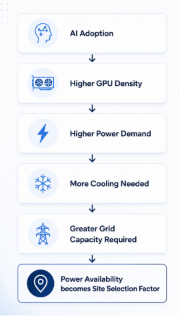
Unlike traditional enterprise applications, AI training and inference rely on clusters of high-performance GPUs operating simultaneously. These processors require significantly more electricity while producing substantially more heat than conventional servers.
As computing density increases, so do the supporting infrastructure requirements. More power is needed not only to operate IT equipment but also to support cooling systems, power distribution, backup infrastructure, and other critical facility operations.
According to the International Energy Agency (IEA), global data centers consumed approximately 415 TWh of electricity in 2024, accounting for around 1.5% of global electricity consumption. The IEA also projects that electricity demand from data centers will continue to rise as AI adoption accelerates worldwide.
In other words, AI is not simply increasing computing demand. It is redefining the scale of energy required to support modern digital infrastructure.
The Challenge Is Not Just Electricity. It Is Power Availability.
When discussing data center growth, it is easy to assume that the biggest concern is whether a country has enough electricity generation.
In reality, the issue is far more complex.
Data centers require electricity that is:
- Available at the right location
- Delivered at the required capacity
- Reliable enough to support continuous 24/7 operations
- Scalable to accommodate future expansion
Even if a country has sufficient electricity generation overall, a project may still face delays if local substations, transmission networks, or grid connections cannot provide additional capacity within the required timeline.
This distinction between electricity supply and power availability has become increasingly important in global data center development.
In several mature data center markets, developers have already experienced project delays because grid infrastructure could not deliver the required capacity despite land, permits, and financing already being secured.
The challenge is no longer simply generating more electricity. It is ensuring that power infrastructure is ready where digital infrastructure is planned.
Why This Matters for Indonesia
Indonesia is entering an important phase in its digital infrastructure development.
Growing cloud adoption, increasing demand for digital services, government digitalization initiatives, and emerging AI investments are all driving demand for new data center capacity.
According to Tenggara Strategics, Indonesia’s data center market is expected to continue expanding significantly over the coming years, supported by the country’s rapidly growing digital economy.
This growth creates tremendous opportunities for Indonesia to strengthen its position as one of Southeast Asia’s leading digital infrastructure hubs.
However, expanding data center capacity requires more than favorable investment conditions.
Power infrastructure must develop alongside digital infrastructure.
Different regions across Indonesia have varying levels of grid capacity, industrial readiness, and supporting infrastructure. As developers evaluate potential sites, power availability is becoming one of the key considerations alongside fiber connectivity, land availability, and proximity to major business centers.
Rather than asking whether electricity exists, developers increasingly need to understand whether sufficient power can be delivered at the required scale and timeline.
As AI adoption continues to accelerate, these roles will become increasingly important. Professionals with the right technical expertise and practical experience will have strong opportunities to grow within the industry.
Cooling Is Becoming Part of the Energy Strategy
Cooling has traditionally been viewed as an operational efficiency issue.
Today, it is becoming part of a broader energy strategy.
Cooling systems can account for a significant portion of a data center’s total electricity consumption, particularly as AI workloads increase rack density and thermal output.
For many years, operators focused on improving cooling efficiency through better airflow management, optimized equipment layouts, and improved cooling technologies.
While those improvements remain important, the industry is increasingly exploring broader approaches that reduce dependence on grid electricity.
These include:
Advanced Cooling Technologies
Liquid cooling and next-generation thermal management systems improve heat removal while supporting higher-density AI workloads.
On-Site Power Generation
Some operators are evaluating localized power generation to improve resilience and reduce reliance on constrained grid capacity.
Microgrids and Distributed Energy Systems
Microgrids offer additional flexibility by integrating multiple energy sources while enhancing operational reliability.
These strategies are not solely about improving Power Usage Effectiveness (PUE). They also help developers design facilities that are better suited to increasingly constrained power environments.
Site Selection Is Being Redefined
Historically, successful data center locations were identified based on several well-established criteria:
- Fiber connectivity
- Land availability
- Business incentives
- Proximity to customers
- Low natural disaster risk
Those factors remain essential.
However, AI is adding another equally important consideration.
Is the power infrastructure capable of supporting long-term growth?
As computing demand continues to increase, power readiness is becoming a competitive advantage.
Developers that can secure reliable power infrastructure early are often better positioned to accelerate project timelines, support future expansion, and meet growing customer demand.
This represents a fundamental shift in how data center locations are evaluated.
Power infrastructure is no longer simply supporting digital infrastructure.
It is becoming one of the primary drivers behind it.
Building Indonesia's Digital Future Requires Energy and Infrastructure to Grow Together
Indonesia has enormous potential to become one of Southeast Asia’s leading digital infrastructure markets. With a large and digitally connected population, a rapidly expanding digital economy, and growing adoption of cloud services and AI, the country is well positioned to attract further investment in data center development.
However, realizing this potential will require more than building new facilities. It also depends on how effectively the broader infrastructure ecosystem evolves. Utilities need greater visibility into future electricity demand to plan capacity expansion, while developers require confidence that reliable power will be available where and when new projects are ready to come online. At the same time, government agencies play an important role in supporting long-term infrastructure planning, and technology providers continue to advance more efficient cooling systems, power management solutions, and sustainable energy technologies.
Ultimately, Indonesia’s digital future will not be shaped by data centers alone. It will be determined by how well digital infrastructure and energy infrastructure grow together to support the next generation of AI, cloud computing, and digital services.
Conclusion
The conversation around data center development is changing.
Land, connectivity, and investment remain essential, but they are no longer the only factors determining project success.
As AI continues to reshape digital infrastructure, power infrastructure is becoming one of the industry’s most strategic assets.
For Indonesia, this shift presents an opportunity to strengthen its digital ecosystem by aligning investments in data centers with long-term energy planning.
The future of digital infrastructure will not be built by technology alone.
It will also depend on the ability to deliver reliable, scalable, and sustainable power where the next generation of AI-powered data centers will operate.


