
BATAM – The Batam AI Data Center Hub is rapidly becoming one of Southeast Asia’s most promising digital infrastructure developments. As demand for generative artificial intelligence (AI) and high-performance computing continues to grow, traditional data center markets such as Singapore and Jakarta are reaching their limits. Batam offers a compelling alternative with its strategic location, low-latency connectivity, geological stability, and business-friendly policies. Together, these advantages are transforming the island from a manufacturing base into Indonesia’s next digital gateway.
Why Singapore and Jakarta Are No Longer Enough
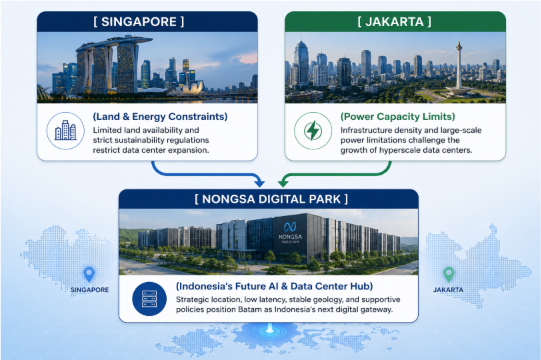
For years, Singapore served as Southeast Asia’s leading data center hub, while Jakarta dominated Indonesia’s domestic market. However, the rapid adoption of AI has dramatically increased computing requirements, exposing infrastructure constraints in both locations.
Singapore's Land Constraints
Singapore faces limited land availability and increasingly strict carbon emission regulations. These challenges have slowed the expansion of conventional data centers and encouraged global operators to look for nearby locations that can accommodate future growth.
Jakarta's Infrastructure Capacity
Jakarta is also approaching its limits, particularly in terms of large-scale power allocation for hyperscale facilities. Modern AI data centers require continuous, reliable electricity to support high-density GPU clusters and real-time computing workloads. As a result, many technology companies are expanding beyond Java to diversify their infrastructure.
Strategic Advantages of the Batam AI Data Center Hub
Batam’s rise as a digital infrastructure destination is built on several competitive advantages.
Low-Latency Connectivity to Singapore
Located just 20 kilometers from Singapore and approximately 45 minutes away by ferry, Batam provides ultra-low network latency of less than three milliseconds. This level of connectivity supports AI model training, cloud computing, financial services, and other real-time digital applications that require fast and reliable data transmission.
International Submarine Cable Connectivity
Batam also serves as a landing point for numerous international submarine cable systems crossing the Strait of Malacca. These cables connect Indonesia directly to global internet networks, improving bandwidth availability and reducing transmission delays.
A Geologically Stable Location
Unlike many regions in Indonesia that lie along the Pacific Ring of Fire, Batam sits in a relatively stable geological area with a lower risk of major earthquakes. This stability gives global enterprises greater confidence when selecting long-term locations for mission-critical digital infrastructure.
Batam vs Johor: Competing for Singapore's Data Center Spillover
Batam is not the only destination benefiting from Singapore’s capacity constraints. Johor Bahru in Malaysia has also become a major investment destination for hyperscale data centers.
Competition Indicator | Batam (Indonesia) | Johor Bahru (Malaysia) |
Existing Capacity | Rapidly expanding with around 18 active projects | Early market leader with more than 5 GW of contracted capacity |
Key Advantage | Special Economic Zone incentives and domestic data sovereignty | Direct land connection to Singapore and JS-SEZ incentives |
Recent Policy | Aggressive tax incentives and investment support | Tighter approvals to improve energy efficiency |
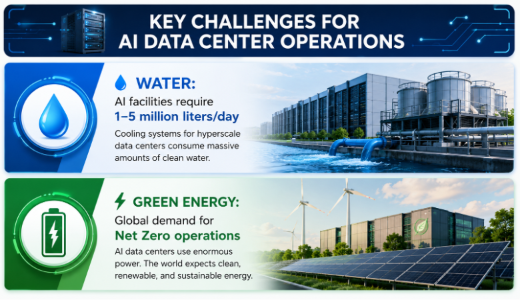
Large AI hyperscale data centers rely on advanced cooling systems that may consume between one and five million liters of water each day.
Research from Fitch Solutions (BMI) highlights Batam’s dependence on rain-fed reservoirs as a potential long-term concern. Some local communities already experience periodic water distribution limitations, making sustainable resource management increasingly important.
To address this issue, BP Batam is evaluating seawater desalination and wastewater recycling technologies similar to those deployed in Saudi Arabia and Johor.
The Biggest Challenges: Water Supply and Green Energy
Although investment continues to accelerate, Batam must address two major infrastructure challenges to support long-term industry growth.
Meeting the Growing Demand for Water
According to market analysis by DC Byte, Johor gained an early advantage because of Malaysia’s mature national power grid. However, recent research from Structure Research shows that Johor has begun restricting new water-cooled data center developments to preserve local resources.
This policy shift creates new opportunities for Batam to attract investors seeking alternative expansion locations. Analysts from Infracrowd Capital also suggest that the SIJORI region, comprising Singapore, Johor, and Batam, could evolve into an integrated regional computing ecosystem rather than competing directly.
Accelerating the Renewable Energy Transition
AI infrastructure also consumes significantly more electricity than conventional data centers. At the same time, global technology companies continue to strengthen their commitments to achieving Net Zero carbon emissions.
Batam’s current electricity supply still relies heavily on natural gas and coal. To improve sustainability, Indonesia is accelerating the development of floating solar power plants across several reservoirs in Batam to provide cleaner electricity for future digital infrastructure projects.
Why Global Technology Companies Are Investing in Batam
Batam’s potential is already translating into large-scale investments.
One of the most significant projects is the Nvidia DSX AI Factory, developed through a strategic partnership between Australia’s Firmus Technologies, Nvidia Corporation, and Singapore-based DayOne. The project represents an investment worth tens of trillions of rupiah and includes a 360-megawatt AI data center campus capable of supporting hundreds of thousands of next-generation Nvidia GPUs.
Meanwhile, NeutraDC, a subsidiary of Telkom Indonesia, has also broken ground on a hyperscale data center facility in Nongsa, further strengthening Batam’s digital infrastructure ecosystem.
The Strategic Role of Nongsa Digital Park
The rapid growth of Batam’s digital ecosystem is closely linked to Nongsa Digital Park (NDP), which operates as one of Indonesia’s Special Economic Zones (SEZ).
The government offers a wide range of incentives within the SEZ framework, including tax holidays, import duty exemptions for advanced technology equipment, and streamlined immigration procedures for highly skilled international professionals.
These policies improve Batam’s competitiveness and make it more attractive to global technology companies seeking long-term investment opportunities in Southeast Asia.
Conclusion
Batam is no longer simply a manufacturing island. It is emerging as one of Indonesia’s most important digital infrastructure hubs.
Its strategic location, international connectivity, geological stability, and strong government support create a solid foundation for AI and hyperscale data center development. At the same time, the island must continue investing in sustainable water management and renewable energy to support long-term growth.
If Batam successfully addresses these challenges, the Batam AI Data Center Hub has the potential to become one of Southeast Asia’s leading AI computing destinations while strengthening Indonesia’s position in the global digital economy.


