
Indonesia’s digital infrastructure is entering a new phase. As artificial intelligence adoption accelerates, data centers are no longer built solely for cloud storage or traditional enterprise workloads. They are increasingly designed to support high-density AI computing, which requires significantly more power, generates more heat, and raises new challenges around energy efficiency.
As the country moves into 2026, Indonesia is being seen as one of Southeast Asia’s strategic markets for digital infrastructure expansion. At the same time, the rise of AI is forcing the industry to rethink how future facilities can scale while remaining aligned with sustainability targets.
Green Data Center Indonesia Is Entering a New Phase in 2026
The conversation around green data center development in Indonesia is becoming more relevant as demand for hyperscale infrastructure grows. Beyond capacity expansion, operators are now under pressure to improve efficiency, reduce environmental impact, and prepare for AI-driven workloads.
This shift is particularly important in tropical regions, where cooling systems often consume a substantial portion of facility energy due to high ambient temperatures and humidity.
How AI Is Changing Data Center Infrastructure in Indonesia
One of the biggest impacts of AI lies in the scale of computing power required. Training and deploying AI models depends heavily on GPU-based servers, which produce much higher heat output than conventional workloads.
As a result, data center design is changing. Operators are moving toward facilities that can support higher rack density and more advanced thermal management systems.
PUE Becomes a Key Efficiency Benchmark
A widely used metric for measuring efficiency is Power Usage Effectiveness (PUE), which compares total facility energy consumption with the energy used directly by IT equipment.
The closer the PUE is to 1.0, the more efficient the facility.
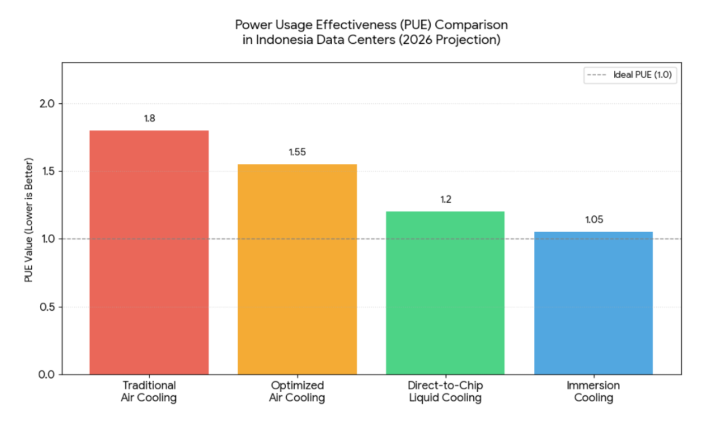
Industry benchmarks suggest that conventional air-cooled facilities often operate within a PUE range of 1.6 to 1.8. In contrast, AI-ready facilities using advanced cooling systems may reach a range closer to 1.1 to 1.2, depending on their design and operational conditions.
The chart below can be inserted here as a visual illustration of cooling efficiency comparisons.
Why Liquid Cooling Matters for Green Data Center Indonesia
As AI workloads increase rack density, liquid cooling is gaining attention as a practical solution for future infrastructure.
Traditional air cooling systems are often less effective for high-density AI environments because of the amount of heat generated by modern GPUs. Liquid cooling offers a more direct way to manage thermal loads.
Typical Industry Benchmark: Air Cooling vs Liquid Cooling for AI-Ready Data Centers
To better understand why liquid cooling is gaining attention, the table below summarizes typical industry benchmarks for cooling approaches used in AI-ready data center environments. These figures represent general market ranges based on publicly available industry reports and may vary depending on facility design, climate, and operational conditions.
Parameter | Air Cooling | Liquid Cooling |
Typical PUE Range | 1.6–1.8 | 1.1–1.2 |
Rack Density Support | 10–20 kW per rack | 50–100 kW+ per rack |
Energy Efficiency | Moderate | Higher |
Water Consumption | Can be higher depending on design | Typically lower in closed-loop systems |
Noise Level | Higher due to large fan systems | Generally lower |
AI Workload Suitability | Limited for very high-density GPUs | Better suited for high-density AI workloads |
Source: Compiled from public industry benchmarks by Vertiv, Legrand, and operator disclosures (2025–2026). Values shown are indicative ranges for educational purposes.
Key Players Supporting AI-Ready Data Center Development in Indonesia
Several major operators in Indonesia have started developing facilities that can support higher-density workloads associated with AI. Some new campuses are being designed to accommodate the increasing power and cooling requirements of AI workloads, including future adoption of advanced cooling technologies such as liquid cooling.
Companies frequently highlighted in this transition include:
- Digital Edge
- BDx Indonesia
- PT DCI Indonesia Tbk
- NeutraDC
- Princeton Digital Group
The transition is also supported by infrastructure vendors such as Schneider Electric Indonesia and Vertiv Indonesia, which are actively introducing advanced cooling solutions tailored for high-density AI deployments.
Conclusion: Why Green Data Center Indonesia Matters in the AI Era
The transformation of Indonesia’s data center industry is no longer just about expanding capacity. AI is pushing operators to rethink infrastructure design, energy efficiency, and long-term sustainability at the same time.
Three major trends are becoming increasingly visible:
- lower-PUE facility design
- adoption of liquid cooling for high-density AI workloads
- stronger integration with renewable energy sources
As these trends continue, green data center Indonesia is no longer just part of a sustainability narrative. It is becoming a practical benchmark for infrastructure that aims to remain competitive in the AI era.


