
Rising Investments and Strong Growth Projections
Indonesia is currently entering an accelerated phase in its data center industry. The rapid growth of the digital economy, increasing demand for cloud services, and the adoption of artificial intelligence (AI) are key drivers of this transformation.
A report by Channel News Asia notes that Indonesia already hosts nearly 200 data center facilities, and this number is expected to grow significantly in the coming years.
This optimism is further supported by data from Mordor Intelligence, which projects that Indonesia’s data center market will grow at a compound annual growth rate (CAGR) of 13.96% through 2029.
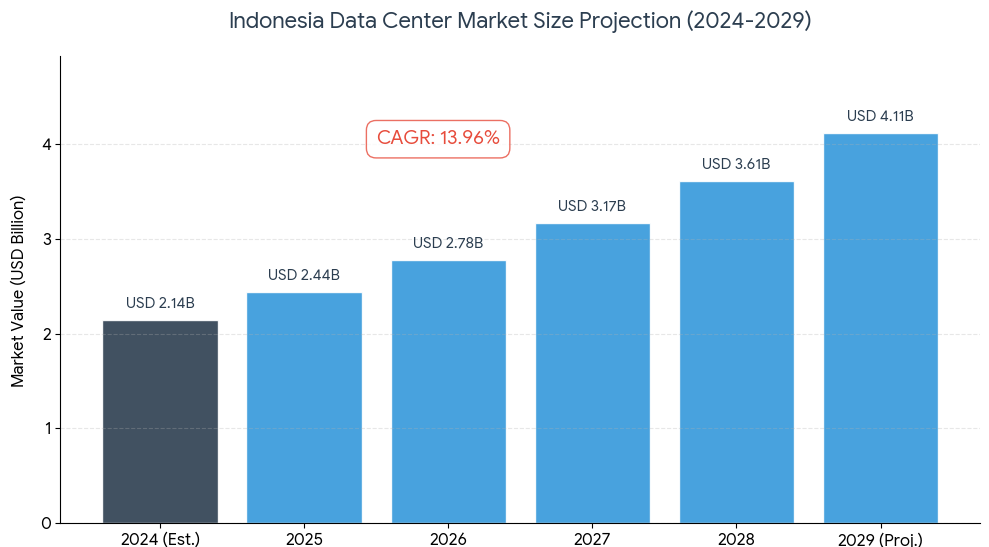
Market Projection: Indonesia’s data center market size is expected to grow significantly through 2029. (Source: Mordor Intelligence, visualized by NDCA).
Global investments are also gaining momentum. Microsoft has committed approximately US$1.7 billion to develop cloud and AI infrastructure in Indonesia. Meanwhile, Digital Edge is developing a hyperscale data center campus in Bekasi with a planned capacity of up to 500MW.
Why Indonesia Is Emerging as a Strategic Choice
1. Spillover Effect from Singapore
As Southeast Asia’s leading data center hub, Singapore is facing constraints in land availability and energy supply. Temporary restrictions on new data center developments have pushed investors to seek nearby alternatives.
In this context, Batam and the Greater Jakarta area (Jabodetabek) have emerged as strategic locations due to their proximity to Singapore and relatively greater availability of land and resources. This dynamic positions Indonesia as a key player in the region’s digital infrastructure landscape.
2. Strengthening Global Connectivity
Indonesia’s advantage extends beyond geography to its growing digital infrastructure.
The development of international subsea cable systems such as Indigo, Echo, and Bifrost has significantly enhanced Indonesia’s global connectivity. These networks enable low-latency cross-border data transmission, a critical requirement for modern digital services and data center operations.
3. Regulatory Support and Data Sovereignty
The government is also strengthening the ecosystem through regulatory frameworks.
Policies such as the Personal Data Protection Law and Government Regulation No. 71 of 2019 require certain sectors to manage and store data domestically. These regulations not only increase demand for local data center infrastructure but also reinforce trust in Indonesia’s data governance.
Sustainability Challenges and Opportunities
Despite its land availability, key regions such as Jakarta are beginning to face capacity constraints. This creates the need for more balanced infrastructure distribution across emerging areas.
At the same time, data centers are energy-intensive operations requiring significant power and cooling systems. In line with Indonesia’s net zero emission target by 2060, this challenge also presents an opportunity.
Industry players are increasingly encouraged to adopt more efficient technologies, such as liquid cooling, to reduce energy consumption and improve operational efficiency. This shift opens the door for innovation in building more sustainable data center ecosystems.
Human Capital: A Strategic Opportunity Amid Talent Gaps
The most crucial challenge in this ambition lies not in infrastructure, but in the readiness of human resources. The data center industry demands specialized expertise—from technicians and network engineers to operational specialists. However, access to hands-on practical learning remains limited due to the stringent security standards of these facilities.
This situation creates a gap between industry demand and the availability of competent professionals. Nusantara Data Center Academy (NDCA) steps in as a strategic initiative to bridge this gap. By providing practice-based training aligned with industry needs, we empower local talent to seize vast opportunities and drive the growth of the evolving data center ecosystem.
Building a Sustainable Digital Ecosystem
To fully establish itself as a Southeast Asian data center hub, Indonesia must strengthen three key pillars:
- Talent development aligned with global standards
- Sustainable and reliable energy infrastructure
- Adaptive regulatory frameworks that keep pace with technological change
With these elements in place, Indonesia has the potential not only to serve domestic demand but also to become a regional growth center for the data center industry.
Conclusion
Indonesia holds strong potential to become a major player in the global data center landscape. Robust investment, strategic location, and market growth provide a solid foundation.
However, long-term success will depend not only on infrastructure development but also on human capital readiness and ecosystem sustainability.
With the right strategies, Indonesia can move beyond being a growing market and position itself as a competitive and influential data center hub on the global stage.


