
Fire Safety in Data Centers: Hidden Risks You Shouldn’t Ignore
Fires in data centers are rare, but when they happen, the impact can be enormous — from equipment damage and operational downtime to potential data loss. A recent incident in a Singapore data center is a reminder that fire safety is not just a regulatory box to tick — it’s a critical part of infrastructure reliability.
That’s exactly what the Nusantara Data Center Academy (NDCA) podcast episode “The Blind Spots: What We Missed About Fire Safety in the Data Center” explores.
Hosted by Genzy Aswa Gusmenda, the episode features two experts:
- Ratna Sari, Fire Sales Leader at Honeywell, and
- Kurniawan Dwi Prasetyo, Director & COO at BDx Indonesia.
Together, they break down key fire safety aspects that are often overlooked — from lithium battery risks to human readiness in emergency situations.
The Main Risk: Lithium Batteries and Thermal Runaway
Data centers are becoming increasingly dense and complex, which creates hotter environments and higher fire risks. Even a minor ignition source can result in significant financial losses and operational disruptions. Effective fire safety measures are therefore essential to maintain continuous operations and protect critical data.
Lithium-Ion Batteries and Thermal Runaway
What is Thermal Runaway
Lithium-ion batteries are essential for backup power systems, but they also present one of the highest fire hazards in data centers. Thermal runaway occurs when a battery cell heats uncontrollably, causing a chain reaction that spreads to nearby cells. This can result in fires that are very difficult to stop once they start.
Why Battery Rooms Are High Risk
The Singapore incident demonstrates the severity of lithium battery fires, as it took more than thirty-six hours to completely extinguish the fire. Proper installation of water-based sprinkler systems in battery rooms can help control temperature and reduce the risk of fire spreading.
Early Detection Is Critical
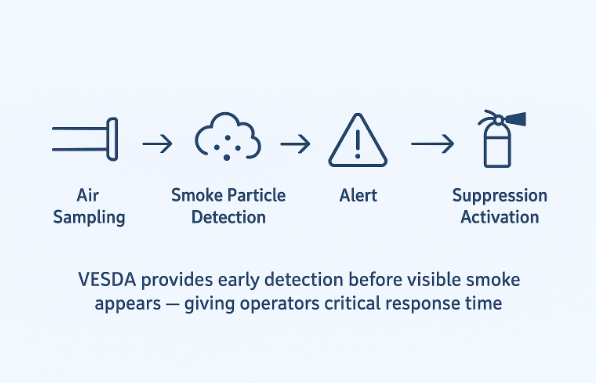
VEWFD and VESDA Systems
Many large-scale fires occur not because suppression systems fail, but because smoke is detected too late. Very Early Warning Fire Detection systems, such as VESDA aspirating smoke detectors, are capable of detecting invisible smoke particles before visible signs appear. Early detection provides operators with crucial time to respond effectively.
NFPA 76 Recommendations
According to NFPA 76, early detection systems are strongly recommended for data halls larger than 232 square meters. Implementing these systems proactively can prevent incidents from escalating into major fires.
Regulatory Landscape
Indonesian Standards
Indonesia has begun adopting international fire standards through SNI 2023, referencing NFPA 72, 75, and 76. Some gaps remain, including clearer sprinkler requirements for data halls and updated regulations for older facilities.
Lessons from Singapore
Singapore enforces stricter regulations, particularly for lithium battery installations. Continuous updates and stronger regulatory enforcement will help make Indonesian data centers safer and globally competitive.
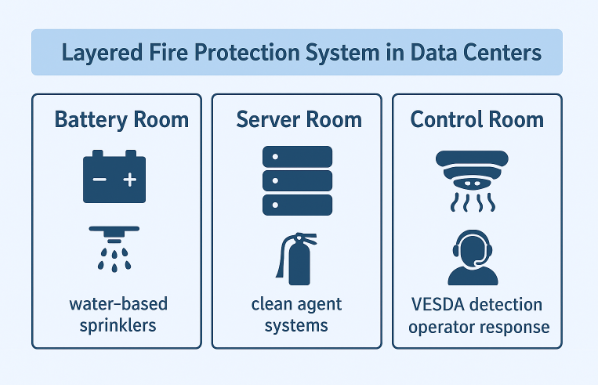
Layered fire protection system across different zones — combining clean agent systems for server racks and water-based sprinklers for battery rooms to balance equipment safety and fire control.
Fire Safety Is a Continuous Process
Both Ratna and Kurniawan stressed that fire safety isn’t something you install once and forget — it’s a continuous process involving design, implementation, and maintenance.
Some key actions include:
- Designing proper battery layout, ventilation, and evacuation paths.
- Using certified fire-rated materials and tested equipment.
- Performing routine system checks and gas pressure testing.
- Conducting regular personnel training and fire drills.
Even the best equipment won’t help if people on-site don’t know what to do when an alarm goes off.
Regulations Need to Keep Evolving
Indonesia has begun adopting international fire standards through SNI 2023, referencing NFPA 72, 75, and 76. However, some areas still need improvement — for example, clearer sprinkler requirements for data halls and updated rules for older facilities.
Singapore, by comparison, enforces stricter regulations, especially regarding lithium battery installations. Continuous updates and stronger enforcement will help make Indonesian data centers safer and globally competitive.
Predictive Technology: From Reactive to Preventive
Technology is also reshaping how fire safety works.
AI-powered monitoring and thermal sensors can detect anomalies — such as unusual heat or early battery degradation — long before they turn into fires.
“These systems don’t replace humans,” said Kurniawan, “but they help operational teams respond faster and make better decisions.”
This shift from reactive response to predictive prevention is transforming data center operations worldwide.
Conclusion
This episode highlights that fire safety in data centers is a shared responsibility. The biggest threats often come from small, overlooked areas — like battery rooms, cable management, or incomplete evacuation drills.
The takeaway is clear: effective fire protection depends on three pillars — proper design, early detection, and human readiness. With those in place, data centers can remain resilient and reliable even in the face of potential fire hazards.
For more details, listen directly to the podcast on YouTube Nusantara Academy and don’t forget to register for training by contacting https://wa.me/6285176950083


