
Vocational education is often promoted as a quick solution to produce job-ready talent. Yet in Indonesia, this pathway remains a second option for many students and parents.
Why is that? What challenges are holding it back? And how can vocational education truly become the driving force of national productivity?
These questions are explored in Nusantara Academy Podcast Episode 10, Season 2: “Vocational Education in Indonesia”, featuring:
- Dr. Ir. Mombang Sihite, MM., DCP, CMA – Board of Director, PT Azbil Berca Indonesia
- T. Agus Sriyono, SJ. M. Hum., M. Sc – Director, ATMI Industry Polytechnic
- Hosted by Dania Rari Pratiwi – Community Engagement Lead, Microsoft
Vocational Education in Indonesia: Strong Potential, Weak Integration
At the start of the episode, the speakers highlight that vocational education in Indonesia is still overshadowed by academic universities.
Unlike countries such as Germany or Switzerland, where industry-school collaboration is deeply integrated, Indonesia is still struggling to build a comparable ecosystem.
Key challenges include:
- Limited industry involvement in curriculum and campus activities.
- Outdated academic requirements — vocational lecturers are required to hold PhDs, though practical experience is more relevant.
- Lack of modern laboratories and equipment that meet industry standards.
The core of vocational education should be knowledge, attitude, and skills built through practice, not just theory.
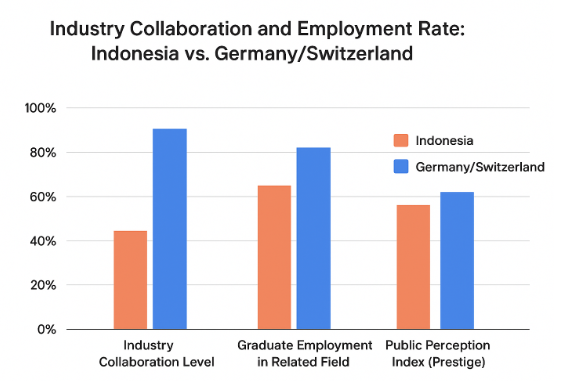
The chart compares vocational education between Indonesia and Germany/Switzerland across three indicators. Industry collaboration in Indonesia stands at around 45%, far below Germany/Switzerland’s 90%. Graduate employment in related fields reaches only 60% in Indonesia, compared to 85% in Germany/Switzerland. Meanwhile, public perception or prestige of vocational education scores about 40% in Indonesia versus 88% in Germany/Switzerland. These figures underline the need for stronger industry integration and cultural recognition of vocational pathways in Indonesia.
Structural and Cultural Barriers: The "Degree Stigma"
According to Romo Agus, the low appeal of vocational schools is deeply rooted in cultural and historical factors.
Since colonial times, Indonesian society has associated higher prestige with academic education and government positions.
This mindset has led to:
- Vocational graduates being viewed as “second-class.”
- Diplomas from Indonesian polytechnics often not recognized by international companies.
- Fragmented governance, as different ministries oversee different vocational sectors (Education, Industry, Marine Affairs).
Such fragmented policy creates poor coordination between schools and industries, making it difficult to synchronize needs and outcomes.
The Solution: Teaching Factories and Industry Collaboration
One of the most promising solutions discussed is the Teaching Factory concept — a campus-based production unit that operates like a real industry.
Students don’t just learn theory; they handle real orders, meet deadlines, and practice quality control, gaining authentic work experience.
Benefits of Teaching Factories:
- Students adapt to actual industry pace and discipline.
- Schools generate income to reinvest in facilities.
- Companies can hire graduates who are job-ready.
However, sustaining a teaching factory requires significant investment and strong public-private collaboration. Without real support, the gap between education and industry will remain wide.
The Impact of Import Culture on Vocational Development
Another compelling topic is Indonesia’s import culture, which weakens local industries and vocational ecosystems.
Dependence on foreign products discourages local production — for instance, imported dairy or poultry products often outperform domestic ones due to tax privileges.
As a result, local vocational programs lose opportunities to produce and innovate, reducing the real-world training experience for students.
If government policies aligned better with local industry development, vocational schools could play a critical role in strengthening local supply chains and creating resilient regional economies.
Nusantara Academy and the Digital Transformation of Vocational Learning
As a bridge between education and industry, Nusantara Academy promotes digital integration in vocational learning.
Today’s industrial machines are no longer purely mechanical — they are digitally controlled, data-driven, and remotely monitored.
This means future graduates must master interdisciplinary skills such as mechatronics, automation, and data engineering.
Through collaboration programs, Nusantara Academy helps schools align curricula with Industry 4.0 standards, ensuring graduates remain competitive in the modern labor market.
Global Demand, Local Recognition: Bridging the Gap
There’s strong global demand for skilled vocational workers — especially in construction, data centers, and manufacturing. Countries like Singapore rely heavily on foreign vocational labor.
However, Indonesian diplomas are still not globally recognized, unlike certifications such as Data Center Professional (DCP).
To compete globally, Indonesia must upgrade its competency standards and certification frameworks to align with international benchmarks.
Policy Recommendations: Aligning Government, Industry, and Society
The podcast closes with several key recommendations:
- Strong government leadership to unify vocational education under clear national policy.
- Regional-based vocational schools tailored to local industries (fisheries, mining, agriculture).
- Incentives for companies that actively collaborate with polytechnics and teaching factories.
- Cultural shift — measure success by skills and contribution, not by academic titles.
Ultimately, vocational education is the backbone of workforce readiness and national productivity.
By combining the efforts of government, industry, and society, Indonesia can turn vocational schools into true centers of innovation and employment.
Conclusion
Vocational education is not a secondary path — it’s a strategic foundation for Indonesia’s future economy.
With aligned policies, modern infrastructure, and social recognition, vocational programs can produce the skilled professionals needed to strengthen both local industries and global competitiveness.
For more details, listen directly to the podcast on YouTube Nusantara Academy and don’t forget to register for training by contacting https://wa.me/6285176950083


