
In recent years, energy efficiency and sustainability have become central topics in the data center industry. The rapid growth of digital and AI workloads has driven a surge in energy consumption, while global pressure to reduce carbon footprints continues to intensify.
So, how can data centers remain reliable, efficient, and sustainable?
This question was addressed in the NDCA Podcast episode “BLAK-BLAKAN SUSTAINABILITY! Rahasia Mencapai Efisiensi di Data Center” featuring two speakers from Schneider Electric Indonesia:
- Ahmad Syaugi – DC RAC Head, Schneider Electric Indonesia
- Christian Soeryoatmodjo – Sustainability Business Consultant, Schneider Electric Indonesia
Hosted by Dewi Gita Wulandari, Sales Engineer at PT. Grundfos Trading Indonesia.
Energy Efficiency Challenges in the Digital Era
Companies today face two major pressures:
- Financial: Electricity cost remains one of the largest operational expenses for data centers.
- Regulatory & Environmental: The global movement toward net-zero carbon emissions makes energy efficiency not just an option but a strategic necessity.
Ahmad Syaugi emphasized the importance of efficiency in data center design:
“If chilled energy from the chiller can be reused instead of wasted, the potential savings are significant.”
Energy efficiency doesn’t rely solely on hardware—it depends on how systems operate in a sustainable cycle.
Technologies Driving Efficiency and Sustainability
1. High-Efficiency Mode UPS
The Uninterruptible Power Supply (UPS) plays a critical role in ensuring power quality in data centers. Traditional double-conversion UPS systems operate with 96–97% efficiency, but new technology now achieves up to 99% efficiency without sacrificing power reliability.
Schneider Electric ensures this performance meets IEC 62040-3 Class 1 standards and is verified by independent bodies such as UL Certification.
Christian Soeryoatmodjo noted:
“A difference of two or three percent may seem small, but at data center scale, it translates to millions of dollars over ten years.”
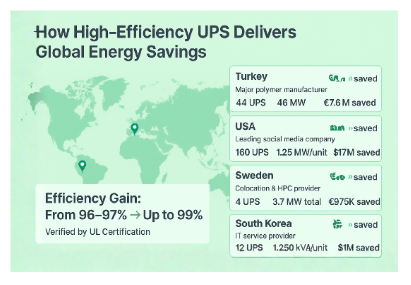
Location | Customer Type | UPS Units | Capacity (MW/kVA) | Duration | Estimated Savings (10 Years) |
Turkey | Major polymer manufacturer | 44 | 46 MW | 3 years | €7.6 million |
USA | Leading social media company | 160 | 1.25 MW/unit | – | $17 million |
Sweden | Colocation & HPC provider | 4 | 3.7 MW total | – | €975,000 |
South Korea | IT service provider | 12 | 1,250 kVA/unit | – | $1 million |
These numbers show that high-efficiency UPS technology offers substantial financial impact without compromising reliability.
2. Smart Cooling and In-row Cooling Systems
Cooling systems are among the most energy-intensive components of a data center. Schneider Electric developed an in-row cooling system with J Point Control technology, allowing higher operating temperatures without reducing performance.
How it works:
- Room temperature is kept higher to reduce cooling demand.
- Unused chilled water is recirculated to the chiller for reuse.
- Automated control maintains water temperature above the dew point to prevent condensation.
This approach delivers significant energy savings, reduces carbon emissions, and simplifies installation by eliminating extra drain piping.
Regulations and the Triple Bottom Line
Sustainability has become a strategic direction for all data center operators globally—not just due to regulation, but because it creates long-term business value.
Ahmad Syaugi emphasized:
“Regulation isn’t a barrier—it’s a catalyst that drives all operators to move at the same level.”
By embracing the Triple Bottom Line—Profit, People, Planet, organizations can balance financial performance with social and environmental responsibility.
Building Data Center Talent and Ecosystems in Indonesia
Schneider Electric’s commitment goes beyond technology—it’s also about developing human capital in Indonesia.
Key initiatives include:
- Schneider White Papers: Over 300 free technical papers on power, cooling, security, and data center software.
- Schneider University: An online learning platform offering professional certifications.
- Center of Excellence in Cimahi, Bandung: A collaboration between the Indonesian and French governments, training thousands of vocational teachers in renewable energy and automation.
To date, more than 38,000 vocational students have benefited from these programs, preparing Indonesia’s future workforce for the sustainable data center and energy industry.
Conclusion: Towards a Sustainable and Efficient Future
Sustainability is not a destination—it’s an ongoing journey requiring innovation, progressive regulation, and talent readiness.
Christian Soeryoatmodjo concluded with a powerful message:
“We can’t wait for perfection to start. What matters is the commitment to start now.”
With the right combination of technological efficiency, continuous education, and policy support, Indonesia has the potential to become a key player in the era of sustainable digital infrastructure.
For more details, listen directly to the podcast on YouTube Nusantara Academy and don’t forget to register for training by contacting https://wa.me/6285176950083


