
As digital infrastructure expands and compute demands accelerate, data centers face a critical challenge: how can facilities continue to scale without compromising energy efficiency or long-term sustainability? With AI workloads driving higher rack densities and power consumption, the fundamentals of layout design and operational efficiency have become central to sustainable data center strategy.
This topic was discussed in depth during the NDCA Podcast, featuring Sanjay Motwani (VP of Global Edge and Channel Business, Vertiv) and Wysnu Eka Lesmana (Solution Architect, Vertiv Indonesia), hosted by Dina Akhmad from the Nusantara Data Center Academy (NDCA). Together, they explored how layout planning, airflow management, cooling strategy, and energy modeling define operational sustainability—and how operators can adapt amid the accelerating energy transition.
Cooling Methods and Efficiency
Cooling remains one of the largest energy consumers in any data center. The efficiency of a cooling system depends not only on the technology itself but also on airflow management, containment, and spatial design.
Airflow Management and Containment
Wysnu explained that hot aisle–cold aisle containment is still a foundational design principle. Proper containment prevents hot and cold air from mixing, ensuring that cooling capacity is used efficiently instead of being wasted in areas that don’t need it.
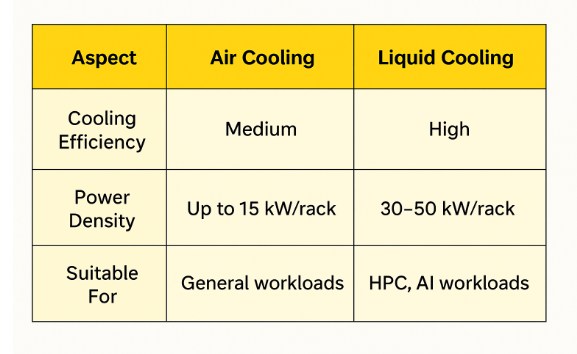
Air Cooling vs. Liquid Cooling
For high-density workloads—such as AI training clusters, HPC workloads, and GPU racks—traditional air cooling often becomes insufficient. The industry is shifting toward liquid cooling, which offers:
Higher thermal efficiency
Better support for >30 kW racks
Lower energy consumption for the same heat load
Hybrid Cooling for High-Density Environments
A hybrid approach—combining containment with rear-door heat exchangers or direct-to-chip liquid cooling—is emerging as the most practical configuration for achieving PUE below 1.5, especially in tropical climates like Indonesia.
How to Prevent Excessive Energy Usage?
Preventing energy waste is not simply about using efficient equipment; it is about balancing workload demand with cooling and power capacity.
Efficiency ≠ Cutting Power Aggressively
Many operators mistakenly believe efficiency means lowering power usage at all costs. Sanjay emphasized that true efficiency is proportional energy usage based on workload need, not arbitrary reduction.
Dynamic, Real-Time Energy Optimization
With integrated energy monitoring and real-time sensors, operators can automatically:
Reduce fan speeds during off-peak workloads
Adjust refrigerant flow
Optimize cooling distribution
Prevent unnecessary overcooling
This approach reduces energy waste, stabilizes temperatures, and extends equipment lifespan.
How Equipment Arrangement Impacts Sustainability
Equipment layout often receives less attention than cooling systems—but it directly impacts airflow efficiency and energy consumption.
Best Practices for Rack Alignment
Wysnu highlighted several key practices:
Align racks with airflow direction
Maintain consistent spacing between racks
Use blanking panels to close empty rack spaces
Install temperature sensors at both hot and cold spots
Impact on Energy Efficiency
Poor rack arrangement can cause:
Cold air to be trapped in unnecessary zones
Heat pockets to accumulate
Cooling units to work 20–30% harder
A well-arranged layout not only improves cooling efficiency but also enhances technician workflow, reduces operational risk, and prevents heat-related downtime.
Reducing Personnel Without Increasing Operational Risk
Automation is transforming data center operations. With the rise of distributed sites and edge locations, the goal is to manage more facilities with fewer people—without increasing operational risk.
AI-Driven Monitoring and Predictive Maintenance
Sanjay explained that modern data centers leverage:
AI-based anomaly detection
Predictive maintenance
Automated alerting for unusual temperature, power, or airflow patterns
Operational Benefits
This allows smaller teams to:
Monitor multiple sites remotely
Respond to issues earlier
Reduce travel and on-site visits
Lower carbon emissions from maintenance operations
Understanding Data Center Energy Models
Energy modeling provides a digital blueprint that connects design, power consumption, cooling performance, and operational behavior.
Why Energy Models Matter
According to Wysnu, simulation tools allow operators to:
Predict the impact of new rack deployments
Test cooling strategy changes
Estimate PUE improvements
Identify potential energy savings
Designing for Data-Driven Decisions
Instead of relying on assumptions, operators can use models to optimize capacity planning, design upgrades, and long-term sustainability targets.
How Data Centers Can Use Less Power
Using less power doesn’t necessarily mean lowering capacity—it means improving how energy is utilized.
Effective Power Optimization Strategies
Implement modular power systems that scale with demand
Combine grid electricity with renewable energy sources
Increase rack density to focus cooling on active zones
Use AI to balance workloads and prevent unnecessary processing
These strategies reduce energy consumption while maintaining reliability and performance.
Goals for the Evolving Data Center Landscape
The data center industry is rapidly changing—driven by AI adoption, edge deployments, and sustainability mandates.
Key Objectives Ahead
Achieve average PUE below 1.5
Increase reliance on renewable or hybrid energy sources
Reduce downtime through automation and smart redundancy
Design flexible, scalable environments for future technologies
Sustainability is no longer optional—it’s a core operational strategy.
Conclusion
Sustainable data center operations are achieved through the synchronization of design, energy modeling, layout strategy, and operational best practices. As discussed in the NDCA Podcast with Vertiv, every element—from cooling configuration to rack arrangement—plays a critical role in shaping long-term efficiency.
With a data-driven approach and intelligent design, Indonesia’s data center ecosystem can continue to grow as a digital infrastructure that is not only powerful, but also sustainable for the future.
For more insights, watch the full discussion on the Nusantara Academy YouTube Channel, and register for professional training via WhatsApp:
https://wa.me/6285176950083


