
The development of data centers in Indonesia is entering a crucial phase. With the rapid growth of the digital economy, the demand for reliable digital infrastructure continues to rise. However, behind this major opportunity lie several strategic challenges—ranging from energy efficiency, power availability, and environmental sustainability, to human resources and carbon emissions.
Developing energy-efficient cooling technologies has become one of the key strategies to improve energy efficiency in data center operations, helping to reduce both carbon footprint and operational costs.
This is the main theme of Podcast Nusantara Episode 6A, featuring two prominent figures in the data center industry:
- Mario Leonardo Tjandra, Sales Director at PT Vertiv Technology Indonesia, and
- Chandra Irawan, Country Manager (President Director) of Pure Data Centres Group Indonesia, and Head of Energy at IDPRO (Indonesia Data Center Providers Organization)
Moderated by Prisca Winata, Senior Sustainability Manager at JLL Indonesia.
The Rapid Growth of Indonesia’s Data Center Industry
According to Chandra Irawan, Indonesia’s current data center capacity is around 120 MW, significantly lower than Japan (800 MW) and Singapore (400 MW). Despite that, Indonesia has immense potential—with 270 million people and over 350 million mobile users.
The COVID-19 pandemic became a turning point for digital acceleration. Activities such as meetings, transactions, and even signing documents shifted to digital formats, driving massive demand for data center infrastructure.
“We don’t want another pandemic, but we have to admit—it was the turning point of Indonesia’s digitalization,” said Chandra.
Energy Efficiency and Data Center Cooling Technologies
Cooling systems are not just complementary—they are a vital component of data center infrastructure. Servers continuously generate heat, and without proper cooling, room temperatures can rise high enough to damage hardware.
One of the biggest challenges in data center operations is the high energy consumption of cooling systems.To better understand how much energy is used for cooling, take a look at the overall energy consumption breakdown in a typical data center.
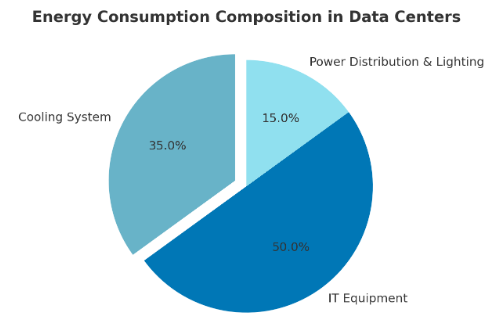
According to McKinsey & Company, 30–40% of total data center energy consumption goes to cooling systems. The more efficient the cooling, the greater the potential for energy and cost savings.
Being a tropical country, Indonesia faces a unique challenge. High annual temperatures increase cooling demand to keep server rooms stable at 18–27°C with 50–80% humidity.
Some efficiency strategies highlighted by the speakers include:
- Hot Aisle & Cold Aisle Containment – organizing server racks to prevent mixing between hot and cold air, improving airflow efficiency.
- CFD (Computational Fluid Dynamics) Simulation – ensuring optimal distribution of cold air among server racks.
- Low Load Strategy – allowing cooling systems to operate in stages based on IT load rather than at full capacity.
- PUE (Power Usage Effectiveness) – a standard metric for energy efficiency; the lower the PUE, the better.
PUE (Power Usage Effectiveness) is a key indicator of how efficiently a data center uses energy. The following chart compares average PUE values across regions.
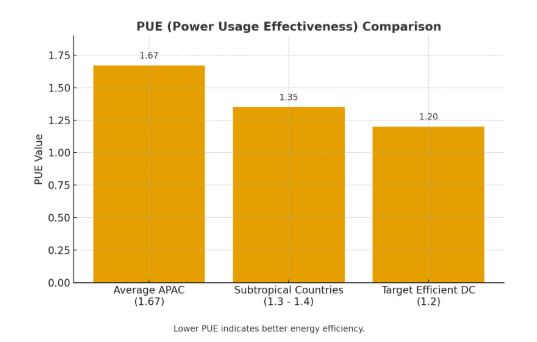
In the Asia-Pacific region, the average PUE is 1.67, while subtropical countries can achieve 1.3–1.4.
Innovation: From Air Cooling to Liquid Cooling
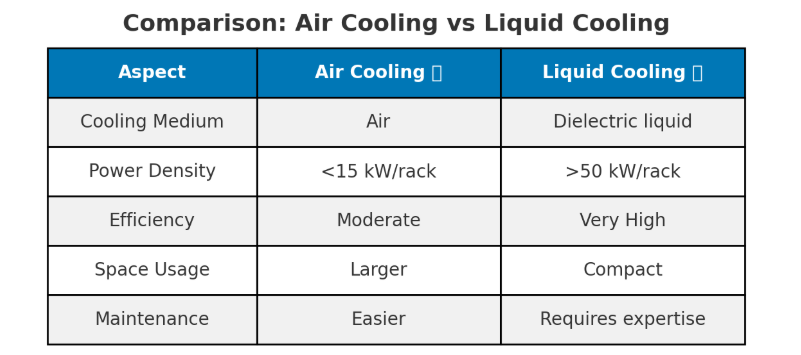
With the rise of Artificial Intelligence (AI) and cloud computing, the power density per server has increased drastically—from 2–10 kW per rack to 40–50 kW or more.
According to Mario Leonardo Tjandra,
“Once it goes beyond 50 kW per rack, it’s time to consider liquid cooling technologies.”
Several innovative solutions are emerging, including:
- Direct-to-Chip Cooling, where the coolant directly absorbs heat from the chip.
- Immersion Cooling, where the entire IT equipment is submerged in a special dielectric liquid.
The result? Heat dissipation efficiency can improve up to 500 times.
The table below highlights the key differences between Air Cooling and Liquid Cooling systems commonly implemented in modern data centers.
Environmental Impact and the Journey to Net Zero
Despite being critical to digital transformation, the data center industry also contributes to global carbon emissions. According to the Climatic Global Report, cloud computing accounts for 2.5–3.7% of total greenhouse gas emissions—surpassing even commercial aviation.
Chandra emphasized the three pillars of sustainability:
- Economic – minimizing waste and promoting circular economy principles.
- Social – addressing poverty and inequality.
- Environmental – reducing carbon emissions and pollution.
To achieve Net Zero Carbon, data centers must manage three emission categories:
- Scope 1: Direct emissions from operations (e.g., generators).
- Scope 2: Indirect emissions from purchased energy.
- Scope 3: Emissions from supply chains and equipment.
“We can’t deny that data centers generate emissions. But we can take responsibility to manage them,” Chandra asserted.
Towards a Renewable Energy Ecosystem
Beyond efficiency, renewable energy sources are also key to long-term sustainability.
Mario highlighted several potential technologies:
- Gas Turbines and Microgrids to replace fossil fuels.
- Energy Storage Systems (ESS) as alternatives to traditional generators.
- Carbon credit mechanisms to incentivize sustainability investments.
However, Mario also noted that the transition is not inexpensive. Collaboration among stakeholders—technology providers, data center operators, investors, and customers—is essential to share both the cost and the benefit.
Collaboration for a Greener Digital Future
In closing, the speakers agreed that data centers are not a “necessary evil” but rather the foundation of the digital economy.
What’s needed now is a collective responsibility to ensure sustainable growth.
“Digitalization is a modern necessity. But sustainability is our shared responsibility.” — Podcast Nusantara Episode 6A.
Conclusion: Towards Efficient and Sustainable Data Centers
Energy efficiency is no longer optional—it’s a core necessity for Indonesia’s data center evolution.
Through innovative cooling technologies such as liquid cooling and immersion cooling, the industry can reduce energy consumption while supporting net-zero goals.
Yet, this transformation can only succeed through cross-sector collaboration—among technology providers, operators, regulators, and consumers.
As digital transformation accelerates, a strong infrastructure must go hand in hand with a shared commitment to a greener, more efficient, and sustainable future.
For more details, listen directly to the podcast on YouTube Nusantara Academy and don’t forget to register for training by contacting https://wa.me/6285176950083


