
As Indonesia’s digital economy continues to grow, data centers have become a crucial backbone supporting this transformation. However, the massive energy consumption of data centers presents a serious environmental challenge. To address this, the concept of Green Data Centers is gaining traction — ensuring digital growth remains aligned with sustainability goals.
In this episode, featuring Mr. Dondy Bappedyanto, Director of Biznet Data Center, and Mr. Wisnoe Pribadi, Head of the Green DC White Paper Team at IDPRO (Indonesian Data Center Provider Organization), and moderated by Rajeni Ray, we explore the challenges and opportunities of adopting Green Data Centers in Indonesia. The discussion covers regulatory barriers, investment issues, technological developments, and rising market demand for energy efficiency and sustainability.
Energy Regulations Limiting Data Center Autonomy
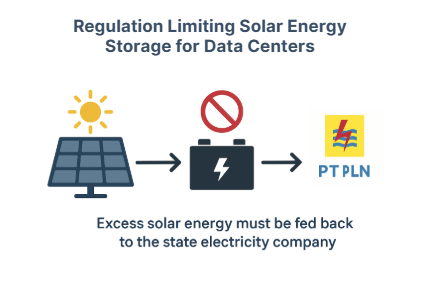
One of the main barriers to implementing Green Data Centers in Indonesia is the regulation that prohibits storing excess solar energy in batteries. Any surplus must be transmitted back to the State Electricity Company (PLN).
This rule limits energy autonomy, making it difficult for data center operators to maximize renewable energy usage. Updated policies are needed to allow greater flexibility and encourage investment in clean energy storage and management.
Fossil Fuel Dominance Amid Renewable Energy Potential
Although Indonesia has renewable energy sources such as hydroelectric power plants in Makassar and Kamojang, most data centers still rely on fossil fuels. This dependence poses environmental and reputational risks in the global market.
Based on official data, Indonesia’s primary energy mix in 2023 was still dominated by fossil fuels:
- Coal: 40.46%
- Oil: 30.18%
- Natural Gas: 16.28%
Renewable Energy: 13.09%
(Source: Indonesia.go.id, 2023)

According to IESR (2024), renewable energy contribution increased slightly from 12.3% in 2022 to 13.1% in 2023, still far from the 23% target by 2025. While PLN’s Renewable Energy Certificate (REC) program marks a positive step, the country’s renewable capacity remains insufficient to meet the rapidly growing energy demand from data centers.
Investment and ROI Challenges in the Green Transition
Building and operating data centers require substantial investment, typically with a five-year return period.
Transitioning to eco-friendly systems means upgrading equipment like UPS units, cooling systems, and electrical panels, adding extra costs before full amortization. Without supportive policies, tax incentives, or strong customer demand, achieving a healthy Return on Investment (ROI) remains difficult.
International Client Pressure Accelerates Green Adoption
Global clients are becoming more environmentally conscious, often asking about the proportion of green energy used by data center providers.
This creates a competitive advantage for local companies that can demonstrate sustainability commitments — while simultaneously driving renewable energy adoption across Indonesia.
Technology Dilemma: Lithium Batteries and Environmental Impact
While lithium batteries offer longer lifespan and better performance than conventional batteries, their manufacturing still relies heavily on fossil energy.
This highlights that “green technologies” are not entirely free from environmental impact. A holistic life-cycle assessment is essential to evaluate the true sustainability of each solution.
Talent Shortage in Data Center Management
Transitioning to Green Data Centers requires new skills in energy management, cooling, and electrical systems. Unfortunately, Indonesia still faces a shortage of qualified professionals.
Programs such as Nusantara Academy and government-run digital talent initiatives are crucial in building a competent workforce to support the growing sustainable infrastructure sector.
Green Data Center Standards and Certification in Indonesia
Indonesia’s SNI 8799 standard provides guidelines for environmentally friendly practices, including safe and energy-efficient site selection.
However, these standards are still less recognized compared to international certifications. Strengthening local certification credibility and aligning with global standards are vital to boost Indonesia’s competitiveness in the regional market.
Strategic Location: Balancing Connectivity and Security
Modern data centers are often located in urban centers to support edge computing and faster data access.
However, these prime locations can be vulnerable to civil unrest or natural disasters. Operators mitigate these risks through advanced security systems — multi-factor authentication, facial recognition, and layered CCTV surveillance — ensuring data integrity and physical protection.
Long-Term Efficiency and Cost Savings
Although green infrastructure requires high upfront investment, long-term operational savings are promising. Improving Power Usage Effectiveness (PUE) can lower energy costs while attracting sustainability-focused clients.However, more empirical financial data is needed to prove the long-term profitability of green data centers in Indonesia.
Collaboration is Key to Green Data Center Success
The success of Green Data Centers in Indonesia depends on strong collaboration between government, operators, vendors, and customers. Supportive regulations, growing market demand, and continuous innovation will form a sustainable ecosystem that drives collective progress.
Educating Customers on the Value of Green Data Centers
Many customers mistakenly believe that the source of energy affects server performance — which is not true. Providers must proactively educate clients on the benefits of green data centers, including energy efficiency, environmental impact, and long-term business value.
A Holistic Environmental Approach: From Technology to Reforestation
Beyond technology, simple actions such as tree planting for carbon offset are being adopted. However, these efforts have limited impact unless combined with larger-scale strategies — such as emission reduction, energy management, and e-waste recycling.
Industry Initiatives Leading Regulatory Change
Before official government regulations are fully established, several companies — such as Biznet — have already begun integrating solar and gas-based power into their operations.
These proactive steps demonstrate that industry leadership can be a catalyst for policy reform and a role model for others in the ecosystem.
Conclusion: Building a Sustainable Green Data Center Ecosystem
Indonesia’s journey toward Green Data Centers will not happen overnight. Adaptive regulations, long-term investment, skilled talent, and cross-sector collaboration form the foundation for a sustainable digital future. With rising global awareness and international client demand, Indonesia holds strong potential to become a sustainable data center hub in Southeast Asia.
For more details, listen directly to the podcast on YouTube Nusantara Academy and don’t forget to register for training by contacting https://wa.me/6285176950083


