
Power reliability is the most crucial factor in data center operations. Even the smallest disturbance can lead to major consequences—from digital service downtime and financial losses to reputational damage. No wonder mitigation strategies before an actual power outage remain a hot topic among industry practitioners.
In this episode of the Nusantara Academy Podcast, experts share insights on challenges, technologies, and practical measures to ensure that data centers remain operational even when the main power supply is disrupted. In Season 2 Episode 9, host Sari Oktaviani is joined by three experienced speakers:
- Ir. Suminto Sosro Saputro, IPU – Senior Advisor of the Indonesia Data Center Provider Organization (IDPRO), an electrical engineering expert with 42 years of experience, and a recent Professional Engineer graduate (IPU) from Universitas Gadjah Mada in 2023.
- Ir. Sucipta Suandi – Founder and CEO of PT Vektor Daya Mekatrika, a provider of Uninterruptible Power Supply (UPS) technology for data centers, with an electrical engineering background and professional certifications in data center operations.
- Agus Suhendar – Assistant Manager of Energy Transactions at PLN UP3 Serpong, with a 16-year career at PLN and a background in Electrical and Industrial Engineering.
Power Outage Mitigation: Generators & UPS as the Backbone
No data center operator wants unexpected blackouts. This is why UPS and automatic generators serve as the backbone:
- UPS instantly supplies power from its batteries when the utility grid fails, bridging the gap until the generator is running.
- The automatic generator kicks in within seconds via an Automatic Transfer Switch (ATS) to continue power supply.
- Once the generator stabilizes, the UPS recharges its batteries to prepare for future disruptions.
Key lesson: without the combination of UPS and generators, the risk of data center downtime rises dramatically.
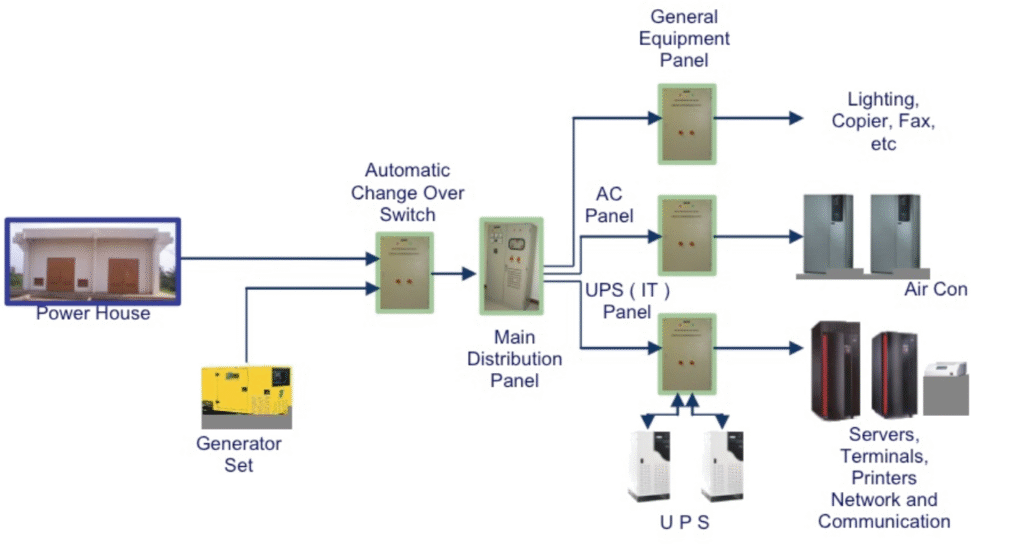
Power flow diagram in a data center: main power from PLN flows into the Main Distribution Panel through the Automatic Change Over Switch. The UPS maintains stable power for IT equipment, while the generator serves as backup when utility power fails.
(Source: APC by Schneider Electric – Data Center Power Infrastructure Guidelines)
The Importance of Fuel Stock
The 2019 mass blackout in Java demonstrated that diesel fuel stock for generators is critical.
- National (SNI) and international standards regulate minimum reserves, typically 24–48 hours.
- Without adequate reserves, operators must scramble for emergency fuel, which is often scarce during widespread blackouts.
- Fuel stock requirements are also part of compliance in data center tiering and certifications.
AI Drives Power Consumption Surge
The rise of Artificial Intelligence (AI) demands far greater power. Some racks now require up to 100 kW per rack.
- Traditional air cooling is no longer sufficient.
- Liquid cooling is the only viable solution at such scale.
- Rack design, power distribution, and airflow management must be redesigned to support high-density servers.
Toward Greener Data Centers
With growing environmental awareness, data center operators are pushed to undergo sustainable transformation.
- Renewable Energy (RE) sources such as solar, wind, and geothermal are being explored.
- However, adoption is still limited. For instance, solar panels are more suited for non-core loads like office or meeting spaces.
A hybrid energy model—combining conventional energy with renewables—is currently the most realistic way to reduce carbon footprint.
UPS Evolution: From Monolithic to Modular
Modular UPS technology has become the new industry standard.
- Monolithic (legacy): bulky, hard to repair, lower efficiency (91–92%), and downtime up to 12 hours.
- Modular (modern): compact, plug-and-play, minimal downtime (5–10 minutes), and higher efficiency (up to 97.5%).
Modular UPS is also more scalable, enabling incremental capacity expansion as needed.
Result: shorter downtime, lower operating costs, and alignment with Green Data Center trends.
Indonesia’s Geographical Challenges
As an archipelago, Indonesia faces unique challenges in power distribution.
- PLN can provide large-scale power supply.
- However, distribution issues persist: transmission routes, land permits, and difficult terrain.
The solution requires close collaboration between PLN, data center operators, and local governments to ensure reliable electricity supply at strategic locations.
PLN’s Role: Reliability Investments & Real-Time Monitoring
PLN is committed to improving reliability through:
- Power plant and grid automation.
- Real-time monitoring systems.
- Redundant network designs (e.g., spindle systems) to reroute supply when one substation fails.
These steps support the growing demand for data centers amid digital transformation and the AI boom.
Conclusion
Mitigating power outages in data centers is not just about turning on a generator during blackouts. A comprehensive strategy is required, including:
UPS and automatic generators as the backbone.
Fuel management in line with standards.
Rack and cooling redesign for AI workloads.
Realistic integration of renewable energy.
Modular UPS for efficiency and rapid recovery.
Careful power distribution planning, especially across islands.
With these approaches, Indonesia’s data centers will not only withstand power disruptions but also evolve toward high reliability and sustainable energy use.
For more details, listen directly to the podcast on YouTube Nusantara Academy and don’t forget to register for training by contacting https://wa.me/6285176950083


