
Indonesia’s banking industry is undergoing a rapid digital transformation. This shift is evident not only in the widespread use of mobile banking and the surge of electronic transactions but also in the growing reliance on data centers as the backbone of financial operations. Without secure, reliable, and sustainable data centers, modern banking services would be highly vulnerable to disruption.
A recent discussion on “Data Center Security and Sustainability in Indonesian Banking” highlighted several pressing issues: physical security and site selection, cybersecurity challenges, and the urgent shortage of skilled professionals in this field.
1. Ideal Locations and Physical Security
As an archipelago prone to natural disasters such as earthquakes, floods, and urban fire hazards, Indonesia faces a dilemma in choosing safe yet practical locations for banking data centers.
- Jakarta and its surroundings remain the preferred location due to stronger infrastructure—stable electricity supply, extensive network connectivity, and better communication systems. However, Jakarta carries a significant earthquake risk and high infrastructure centralization, which could lead to systemic disruption in case of a large-scale disaster.
- Kalimantan is safer from earthquakes but still lacks sufficient infrastructure, making it less suitable for data center deployment at this stage.
Most banks build and own their own earthquake-resistant facilities. These are typically low-rise buildings, designed with resilience as the top priority.
For example, BCA operates two data centers within 30 km of each other in Jakarta, plus a disaster recovery site in Surabaya. This design ensures operational continuity even if one center fails. The ultimate commitment is to maintain 24/7 transaction availability, ensuring zero disruption to customers.
2. Business Continuity Planning
In banking, even a few seconds of downtime can translate into significant financial and reputational losses. This makes business continuity planning (BCP) a top priority.
While much of Indonesia’s financial infrastructure—such as Bank Indonesia and other major institutions—is centralized in Jakarta, banks still aim to separate data center sites as far apart as possible to reduce systemic risks.
Continuity planning includes more than just site distance. It also involves backup systems, disaster recovery procedures, and rapid activation protocols to safeguard core services and customer trust.
3. Cybersecurity: The Invisible Enemy
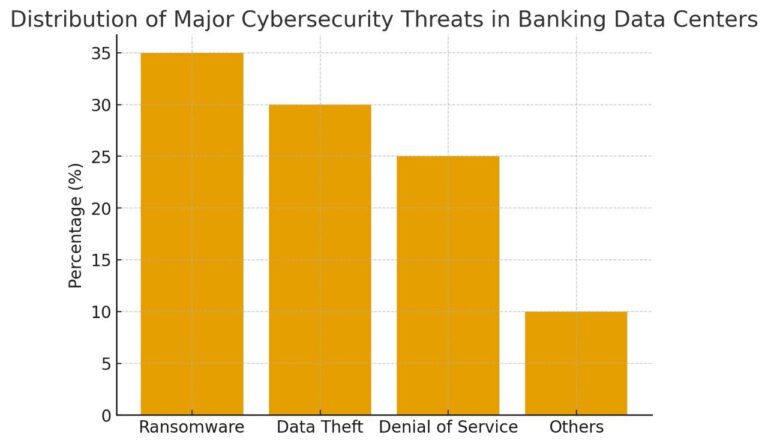
Beyond physical risks, banks face increasingly sophisticated cyber threats. Securing digital infrastructure requires a multi-layered approach—covering data center design, access control, employee devices, and external vendors.
Top Three Cyber Threats:
- Ransomware – Attackers encrypt data and demand ransom for release.
- Data Theft – Information is stolen without destroying systems, often with long-term implications.
- Denial of Service (DoS) Attacks – Overwhelming systems with traffic, rendering services inaccessible.
Additional Threats:
- Phishing emails, which surged during the COVID-19 pandemic.
- Internal virus outbreaks spreading through local networks.
- Leaks from vendors or careless employee behavior on personal devices.
Key Protection Strategies:
- Early warning systems to detect suspicious keywords in communications.
- Regular review of access and data usage policies.
- Staff awareness programs on data confidentiality.
- Deployment of encryption, anti-virus software, and multi-factor authentication.
- Independent security audits and penetration testing to identify vulnerabilities objectively.
Currently, cooperation with government agencies and law enforcement is mostly reactive, initiated only after fraud or crime occurs. The industry must move toward proactive partnerships to prevent attacks before they materialize.
4. Talent Shortage: The Human Resource Challenge
Technology is only as strong as the people who manage it. One of Indonesia’s most critical challenges lies in the severe shortage of qualified data center professionals.
Unlike software development or other IT disciplines, data center management lacks formal academic programs in local universities. Most professionals acquire expertise on the job rather than through structured education.
Yet, data center engineers need a rare combination of skills:
- Electrical engineering (power supply, UPS, generators).
- Mechanical systems (cooling, fire suppression).
- IT and networking (servers, security, storage).
- Business acumen (understanding how downtime directly translates into financial losses).
Large banks like BCA offer internal training, but the focus is often on networking and business rather than core data center competencies.
Given that Indonesia’s data center market is projected to grow by 11.4% annually, this talent gap will only widen. Without targeted investment in education and training, Indonesia risks overreliance on foreign expertise.
Needed Solutions:
- Developing formal university curricula for data center engineering.
- Establishing local training centers with Bahasa Indonesia-based modules.
- Industry–government–academia collaboration to build a local talent pipeline.
- Raising awareness that data center engineering is a promising career, not just a behind-the-scenes job.
5. Future Directions: Security and Talent as Strategic Investments
The discussion concluded with several forward-looking recommendations emphasizing that data centers are not just technological assets but also strategic drivers of business and national economic resilience.
Key Priorities for the Future:
- Integrating security at the design stage of systems and applications, not as an afterthought.
- Strengthening infrastructure coordination, especially electricity and telecommunications, to prevent disruptions during major government projects.
- Expanding and professionalizing data center teams to keep pace with rising data volumes and transaction complexity.
- Comprehensive disaster recovery planning that addresses both physical risks and cyber threats.
- Long-term investment in talent development, including education, training, and certification.
Conclusion
Data centers are the digital heartbeat of Indonesia’s banking industry. Their reliability and security determine not only customer trust but also the overall stability of the financial system.
Yet, challenges remain. Jakarta’s earthquake risks, increasingly complex cyberattacks, and a lack of skilled professionals present serious vulnerabilities. Solving these issues will require investment in both infrastructure and human capital.
If addressed with urgency, Indonesia can not only safeguard its banking ecosystem but also position itself as a competitive hub in the regional data center industry.
Careers in data center management may be underrecognized today, but the future demand is undeniable. As digital transformation accelerates, banks, government, and academia must collaborate to cultivate the next generation of Indonesian data center talent—ensuring the security, sustainability, and competitiveness of digital banking services for years to come.
For more details, listen directly to the podcast on YouTube Nusantara Academy and don’t forget to register for training by contacting https://wa.me/6285176950083


